13 Free App Marketing Ideas That Actually Work in 2026
I launched my first app with a $0 marketing budget. Six weeks and a lot of trial and error later, here are the 13 free ideas that actually drove downloads, and the ones that were a complete waste of time.

Cyrus
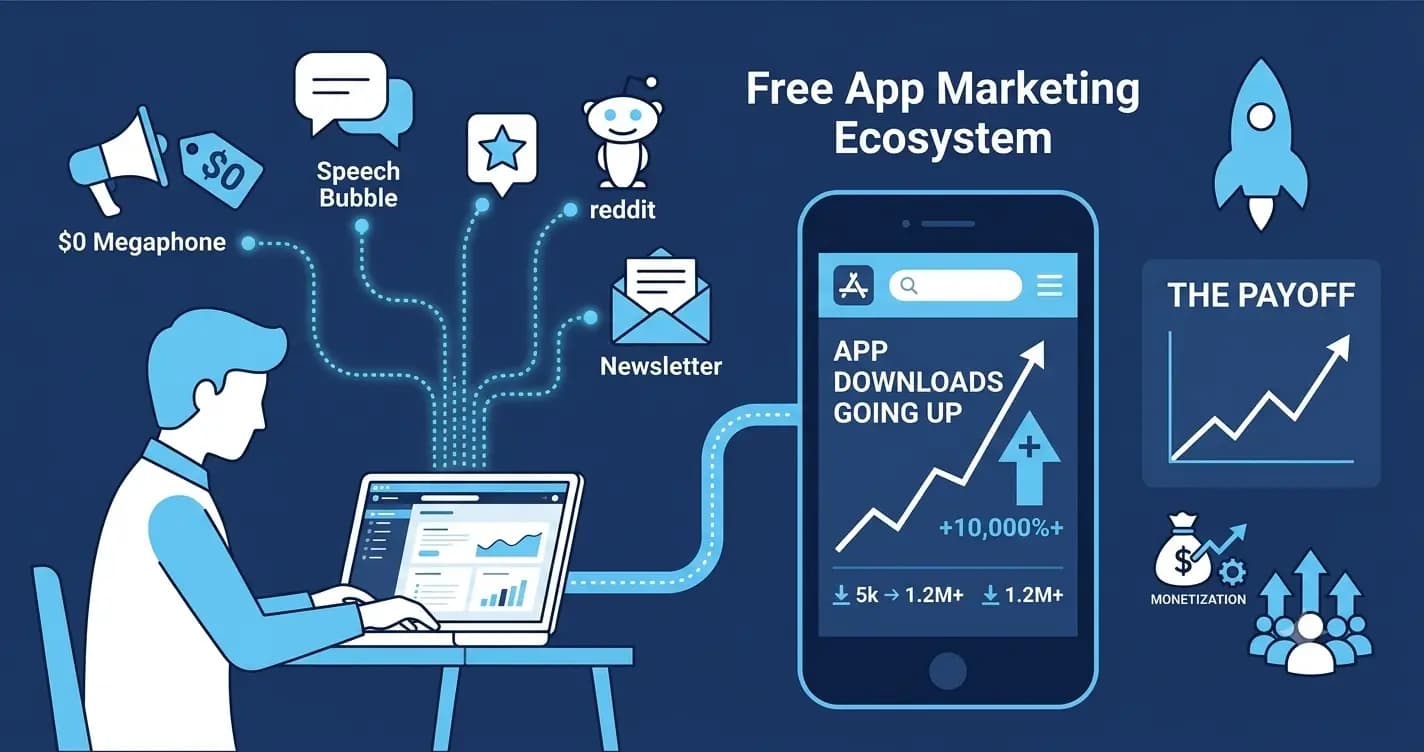
The first app I marketed had a $0 budget. Not by choice. By circumstance.
We had spent everything we had on building. By the time we were ready to launch, there was nothing left for ads. I remember sitting with the team the night before launch and someone saying, half joking, that we should just tweet about it and see what happens.
We did not just tweet about it. We spent the next six weeks trying every free marketing channel we could find, reading everything, testing everything, failing at most of it, and occasionally hitting on something that actually moved the needle. That period taught me more about app marketing than any paid campaign I have run since. Because when you have no money, you cannot hide behind a budget. You have to be genuinely useful, genuinely interesting, or genuinely connected to the people you are trying to reach.
Here is what we learned, updated for 2026. These are 13 free app marketing ideas that produce real results. Not theory. Not things that might work. Things I have done, seen done, or both. In 2026, with iOS CPI averaging $5.84 per install (Digital Applied, 2026), the value of a free channel that drives even 100 quality installs a month is not small. It is $584 in acquisition cost you did not spend.
Before the Ideas: One Thing That Changes Everything
Every free marketing channel in this list performs better if you have one thing in place before you start: a landing page that is not your app store listing.
Your store page is controlled by Apple and Google. A dedicated landing page is yours. You can link to it from Reddit without it looking like a store redirect. You can collect emails from people who are not ready to install yet. You can rank on Google for your app's keywords. You can send press and influencers somewhere that feels like a real product, not just a store thumbnail.
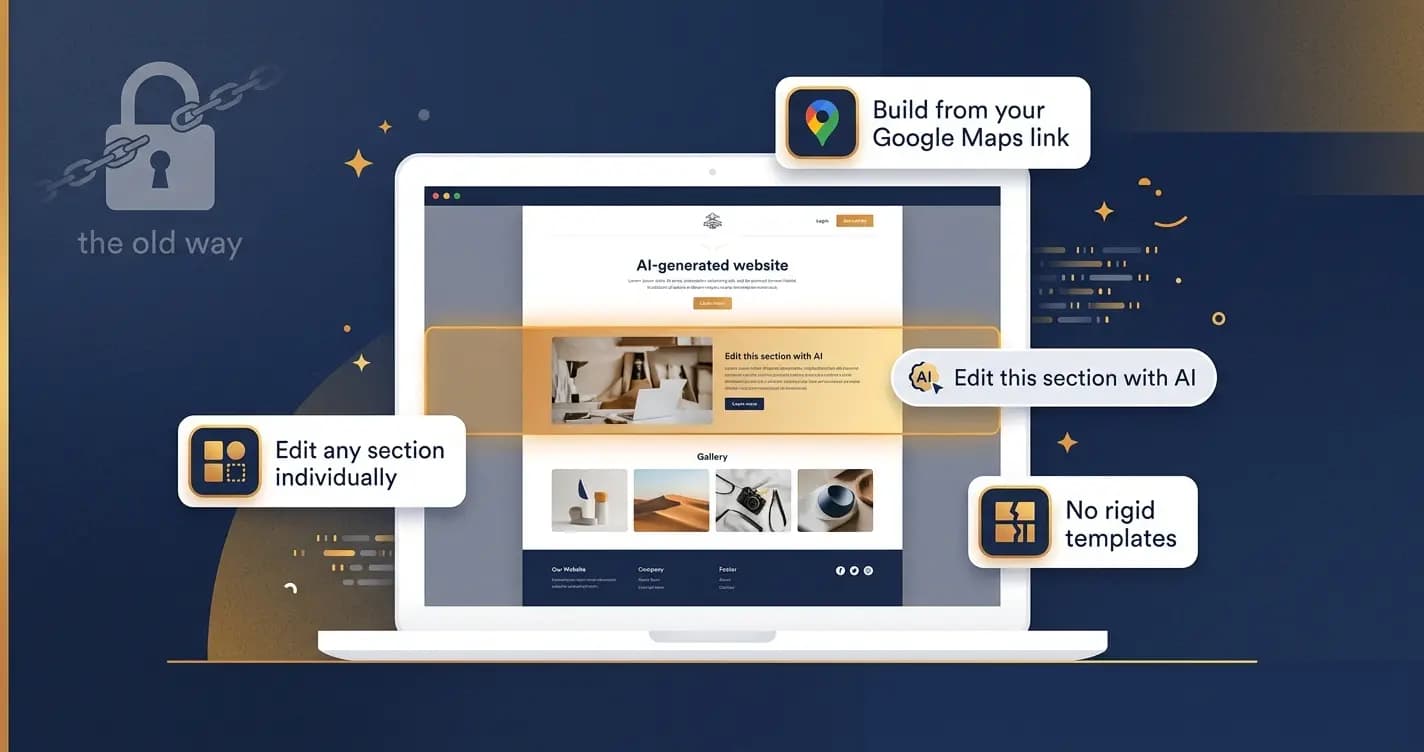
If you do not have one yet, the fastest way to build it in 2026 is to paste your App Store or Google Play link into Entro. It generates a professional landing page from your store listing automatically, in under 5 minutes. That landing page becomes the home base for almost every idea in this article.
1. Optimize Your App Store Listing (ASO)
I will start here because it is the one free marketing idea that works while you sleep and compounds every single month.
In 2026, search drives 65% of iOS app discovery (Apple, 2025). More than half of all new app installs begin with a user typing something into the App Store or Google Play search bar. If your listing is not optimized for the keywords those users are typing, you are invisible to the majority of your potential audience, regardless of how good your app is.
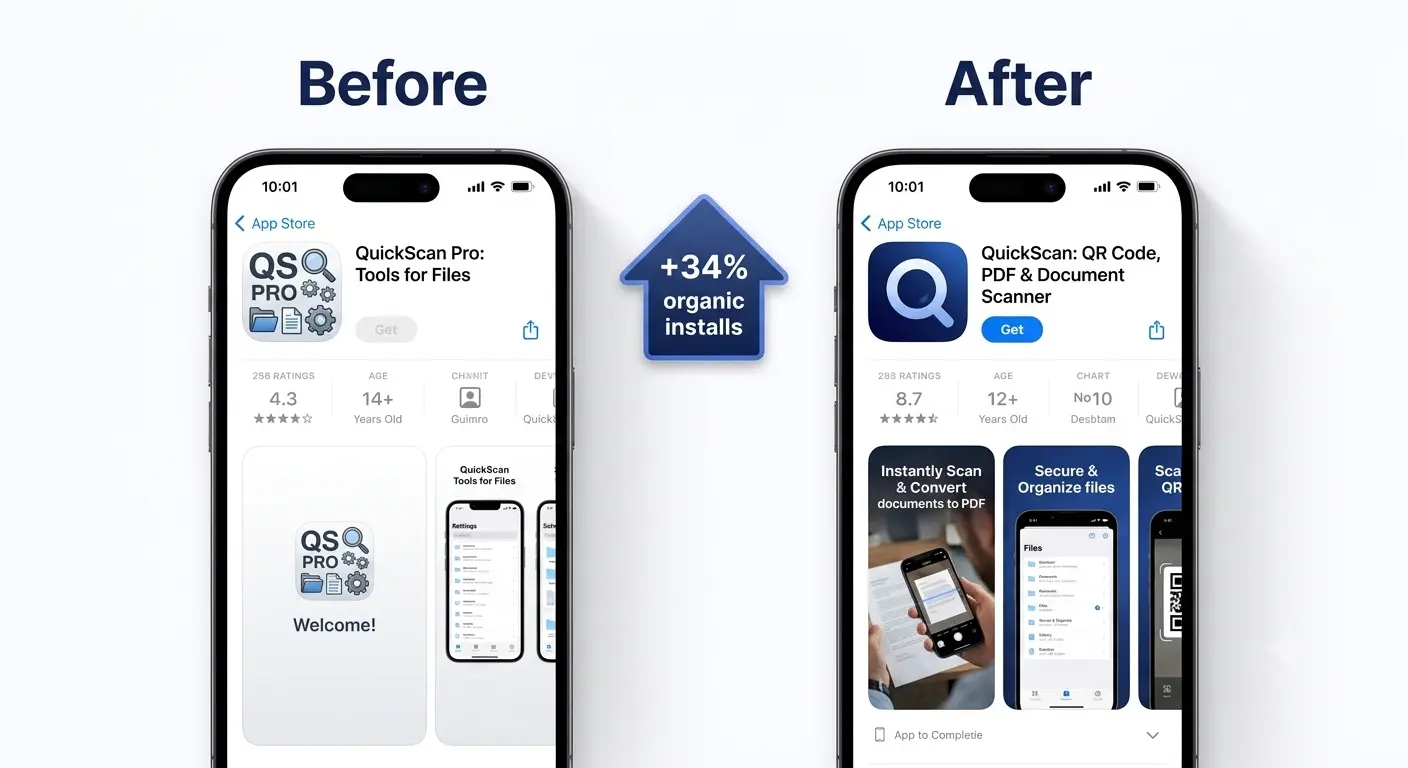
I once spent an afternoon reworking the title and subtitle of a fitness app I was working on. Nothing else changed. No new screenshots, no new copy, no new reviews. Just the title and subtitle, with the primary keyword placed more naturally and a secondary keyword added to the subtitle. Within three weeks, organic installs were up 34%. I had not run a single ad.
What to focus on in 2026
App title: include your primary keyword naturally. Not stuffed. Naturally.
Subtitle or short description: your second shot at keyword placement. Use it for a secondary keyword alongside your value proposition.
Long description: keyword-rich but benefit-led. The first three lines matter most on iOS because they appear before the 'More' fold.
Screenshots: your first screenshot should communicate one specific benefit in under 2 seconds. Not your logo. The product in use.
Ratings: a 4.0+ rating is now effectively a prerequisite for appearing in featured sections. Getting there is idea 5 in this list.
2. Show Up Honestly on Reddit
Reddit is where I have seen the most dramatic free marketing results in the last two years, and also where I have seen the most spectacular self-inflicted failures. The difference between the two is almost always the same thing: authenticity.
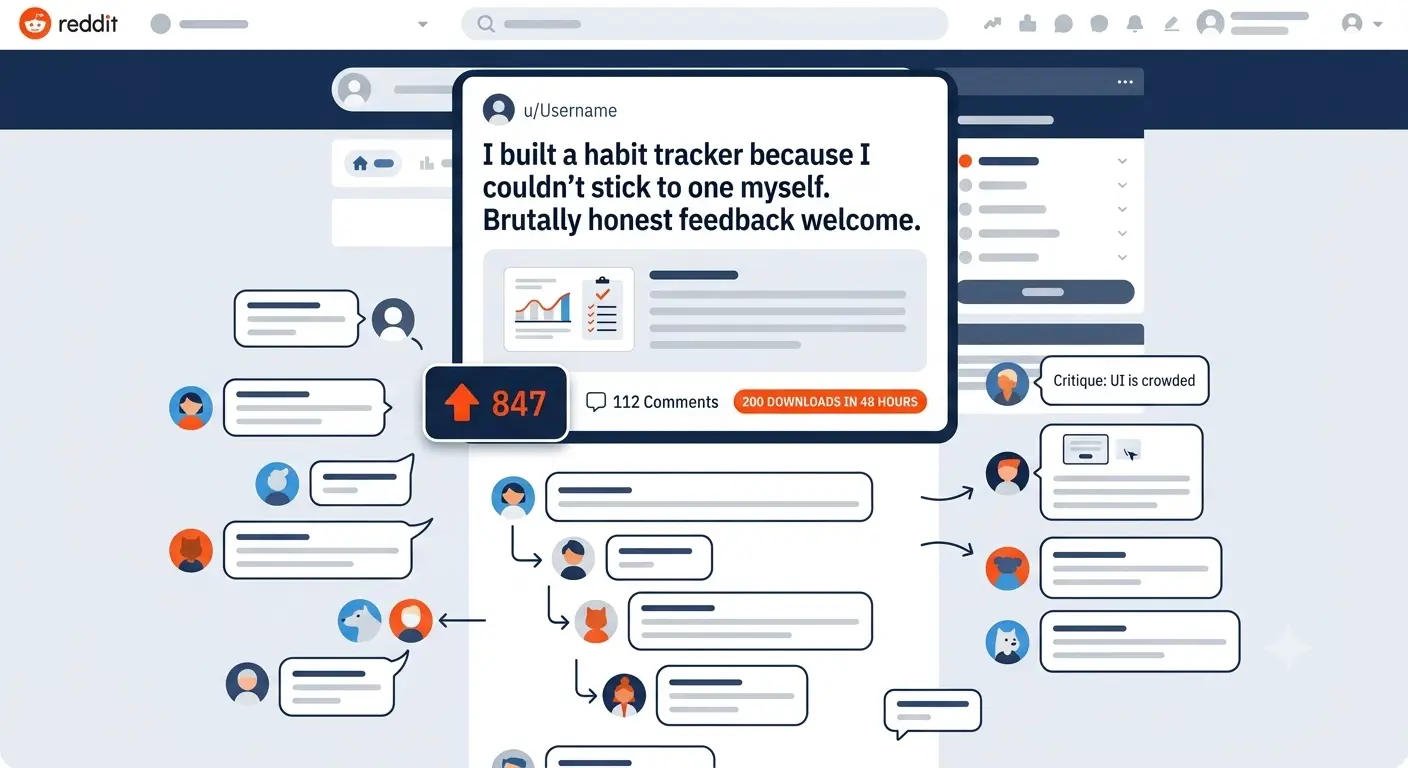
The failures happen when someone joins a subreddit, posts 'Hey everyone, check out my new app!' with a download link, and gets immediately roasted in the comments and the post removed by the moderators. The wins happen when someone has been genuinely participating in the community for weeks, answers questions helpfully, and then one day says 'I built something that solves this problem I kept seeing people ask about here. Would anyone want to try it?'
I know a developer who got 200 downloads in 48 hours from a single Reddit post with zero budget. He had been active in the subreddit for three weeks before posting. His post was honest, slightly vulnerable about the challenges of building alone, and directly relevant to a problem that subreddit regularly discussed. The community responded because it felt like someone talking to them, not marketing at them.
How to do this without getting banned
Find the 3 to 5 subreddits where your exact target user spends time. Not general technology subreddits. Specific ones.
Read the rules of each subreddit before posting anything. Many have specific policies about self-promotion. Respect them.
Contribute genuinely for 2 to 4 weeks before mentioning your app. Answer questions. Share knowledge. Be a real participant.
When you do post your app, lead with the problem it solves and the story of why you built it. Not the features. Not the download link in the first sentence.
Respond to every comment, including the critical ones. Especially the critical ones. The community is watching how you handle feedback.
3. Launch on Product Hunt
Product Hunt is still one of the few places in 2026 where a completely unknown app can reach thousands of early adopters in a single day, for free.
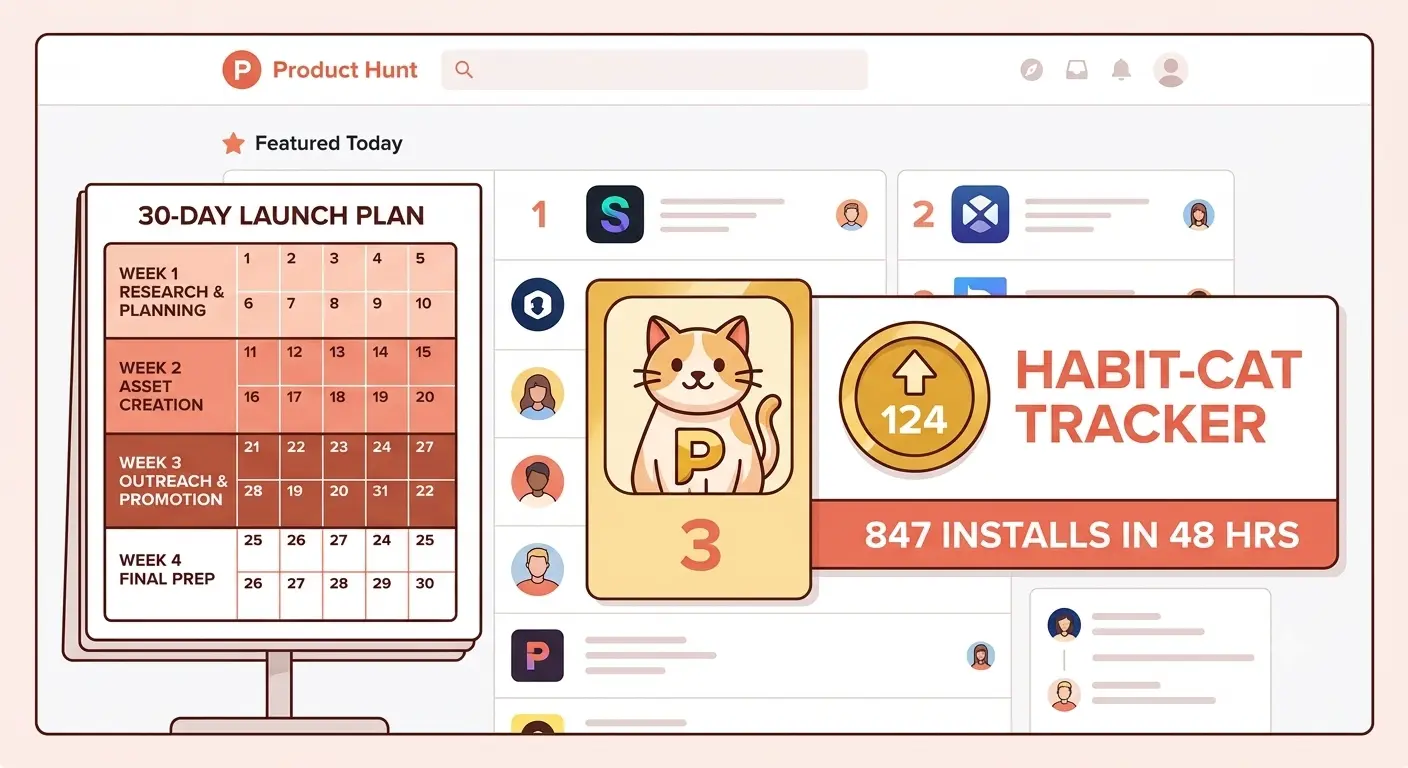
I have launched three products on Product Hunt. The first two were impulsive, under-prepared, and quietly forgotten. The third was planned for 30 days in advance. We prepared our maker profile, lined up supporters who had actually used the app to vote on launch day, wrote the maker comment the night before so it was thoughtful and honest, and chose a Wednesday launch date because data consistently shows Tuesday to Thursday get the best engagement on the platform.
That third launch put us in the top 10 for the day, drove 847 installs in 48 hours, and got picked up by two newsletters in our category that then wrote about the app to their own audiences. All free. All because we prepared properly instead of just hitting submit.
What actually determines a good Product Hunt launch in 2026
Prepare 30 days out. Age your maker profile. Complete it fully. An empty profile screams 'I created this account just to post this.'
Your maker comment on launch day is more important than your tagline. Write it like you are talking to one curious person, not presenting to a crowd.
The first 6 hours (Pacific Time, from midnight) determine your daily ranking. Concentrate your genuine supporters in those hours.
Respond to every comment within an hour throughout launch day. Engagement velocity affects your ranking on the platform.
After the day is over, repurpose your launch results as social proof. 'Featured on Product Hunt' is a trust signal that continues working for months.
4. Build Your Email List Before You Need It
The most valuable asset I have seen any app team build for free is an email list that predates the launch.
On the first app with zero budget, we put up a landing page six weeks before launch with nothing but a headline, a single screenshot, and an email field that said 'Get early access when we launch.' We shared it in our personal networks. We posted it in two relevant forums. We emailed it to 30 people we thought would genuinely care. By launch day we had 340 email addresses.
Those 340 emails generated 212 installs on day one. That install velocity, concentrated in the first 24 hours, triggered enough ranking movement in our category that we started showing up organically in related search results within a week. The email list did not just drive installs. It seeded the algorithm.
Email marketing averages $36 returned for every $1 spent across all industries. For apps specifically, a pre-launch list has a compounding benefit: early installs from warm leads tell the app store algorithm your app matters, which generates organic installs you did not have to earn through marketing.
How to build this list for free
Put a landing page live the day you decide to build the app. Not the week before launch.
Offer something specific for signing up: early access, a free premium month, a feature named after the first 100 signups. Make it feel exclusive.
Share it everywhere you already have an existing audience: your LinkedIn, your Twitter/X, your newsletter if you have one, your personal email to friends in your target market.
Submit your coming soon page to BetaList and Product Hunt's Upcoming section. Both are free and read by early adopter audiences.
5. Engineer Your Review Timing
This one sounds small until you see what a half-star rating change does to your conversion rate.
Apps that improved their rating from 3.6 to 4.2 stars saw 60% higher conversion rates (AppTweak, 2026). 90% of featured apps on the App Store maintain ratings of 4.0 or higher. Your rating is not just social proof. In 2026, both stores use it as a ranking signal. A low rating suppresses your organic visibility regardless of how good your ASO is.
We had a 3.4 star average on the habit tracker I mentioned earlier. Not because users hated the app. Because we were prompting for reviews at the worst possible moment: on first open, before the user had done a single thing. Of course people ignored it or dismissed it with 3 stars. They had no experience to rate yet.
We moved the prompt to trigger after a user completed their seventh consecutive daily streak. That is a moment of genuine satisfaction. Someone who has built a 7-day habit is the person most likely to give you 5 stars. Within 60 days, our rating moved from 3.4 to 4.3. Our weekly organic installs went up without any other change.
The engineering approach to reviews
Identify your app's 'moment of peak satisfaction.' The instant after the user achieves something real. That is when you ask.
Build an internal feedback path before the store prompt. A simple 'Something not working?' button catches frustrated users before they go to the store.
Respond publicly to every negative review within 48 hours. Not defensively. With acknowledgment and a fix timeline if possible.
Email your most engaged users directly asking for a review. People who have opened the app more than 5 times in the first week are your best advocates.
6. Write One Piece of Content a Week
Paid installs are rented. Content installs are owned.
A blog post that ranks on page 1 of Google for a keyword your target user searches drives installs for years with zero incremental cost. I have articles that were written two years ago that still drive 15 to 20 installs a month without any maintenance. That compounds. Twelve articles means 180 to 240 free installs a month from content alone, running indefinitely.
The key in 2026 is that Google's Helpful Content signals now heavily weight first-hand experience. Generic, AI-generated articles about your app's topic are flooding search results and being filtered out. The content that wins is specific, experiential, and written by someone who has actually done the thing. Which means the best content marketer for your app is you, the person who built it and knows the problem better than anyone.
What to write
How-to guides that solve the exact problem your app addresses. Not what your app does. What the user needs to accomplish.
Comparison content: your app versus the alternatives people are already searching for.
Personal story content: why you built the app, what problem you personally had, what you tried before building your own solution.
Niche use case content: specific audience segments using your app in ways you did not expect. These rank for long-tail keywords with very high intent.
Publish on your own domain. Not Medium. Not LinkedIn. Every piece of content published on someone else's platform builds their authority, not yours.
7. Post 30-Second Screen Recordings
This is the highest-ROI free content format available to app teams in 2026 and the one most developers ignore because they think they need a camera, a microphone, and a production setup.
You do not. You need your phone and a screen recording.
The best app marketing content on TikTok and Instagram Reels in 2026 is not polished brand videos. It is a developer holding their phone, recording their screen, and saying 'I built this in three months and here is what it does.' Authentic. Slightly rough. Real. TikTok was the most downloaded app globally in 2025 with 730 million downloads (data.ai, 2026) and its users have an extraordinary sensitivity for when content is genuine versus when it is marketing.
I posted a 28-second screen recording of a feature I was proud of on a Monday morning with zero followers on a new account. By Thursday it had 14,000 views and 180 profile link clicks. Not because it was beautifully produced. Because it showed something real that solved a real problem in under 30 seconds.
What actually works on short video in 2026
Open with the problem, not the solution. 'If you always forget to drink water...' performs better than 'Check out my new hydration app.'
Show the app in real use, not a demo recording with fake data. Real screenshots, real numbers, real use cases.
No voiceover needed. Most short video is watched silently. Text callouts on screen are enough.
Post consistently, 3 to 5 times a week, rather than perfectly once a month. Volume beats polish on short video platforms.
Reply to every comment in the first hour. The algorithm rewards comment engagement with extended reach.
8. Find One App to Cross-Promote With
This is the most underused free marketing channel I know of. And the one that, when it works, feels almost unfair.
Cross-promotion means finding an app with a similar-sized audience and a non-competing use case, and agreeing to feature each other. You send your users to them. They send their users to you. Both sides acquire users at zero cost because you are borrowing each other's trust with an already-engaged audience.
The version that worked best for me was simple. I reached out to the developer of a productivity app in our same general space with about the same number of monthly active users. We agreed to each add a single 'You might also like' card inside our apps pointing to the other. No money changed hands. Over three months, that single card drove 340 installs for our app and a similar number for theirs. It cost both of us an afternoon of development work and nothing else.
How to find the right cross-promotion partner
Look for apps in your category that complement rather than compete. A habit tracker and a journaling app. A recipe app and a grocery list app. A meditation app and a sleep tracker.
Match audience size. A 10,000-user app partnering with a 1-million-user app is asking for a favour. Match your tier for a genuine equal exchange.
Start small. Propose a mutual mention in each other's onboarding email before you discuss in-app integrations. Prove the install flow works before building anything.
Track it with a UTM link or a promo code so you both know what the other is actually driving.
9. Become Genuinely Useful in Online Communities
Beyond Reddit, there are dozens of niche online communities where your exact target user already gathers. Discord servers. Facebook Groups. Slack workspaces. Indie hacker forums. Category-specific forums. LinkedIn groups. Quora answer threads.
The strategy in all of them is identical to Reddit: be genuinely useful first. For a long time. Then mention your app when it is relevant.
I spent two months actively answering questions in a Facebook Group for small business owners, the exact audience for a productivity app I was working on. I did not mention the app once in those two months. I just helped. By the end of two months, members of the group were messaging me privately asking what tools I used. When I mentioned the app, eight of them downloaded it the same day and three of them became paying subscribers. Eight downloads sounds small. But they were the highest quality eight downloads I had seen, with Day-30 retention that was three times our paid acquisition average.
Quality over quantity is what free community marketing delivers. The users you earn through genuine helpfulness stay longer, rate better, and refer more.
10. Submit to Free App Directories and Review Sites
Before you spend money on PR, exhaust the free options. There are more than most developers realize.
AlternativeTo, AppAdvice, 148Apps, BetaList, AppSumo (for applicable categories), GetApp, G2, Capterra for business tools, and dozens of category-specific review sites all accept free submissions. A single listing on AlternativeTo has driven long-tail organic traffic to several apps I have worked on for two or more years after the submission.
The other free PR channel that gets overlooked: emailing journalists who have covered apps like yours. Not a press release. A two-paragraph email that names a specific article they wrote, explains why your app is a follow-up to that story, and offers them a working build to try. I emailed 12 journalists with this approach for one launch. Two responded. One wrote about the app. That single article drove 1,100 installs in three days and a backlink that still passes authority two years later.
Free directories worth submitting to
AlternativeTo: long-tail SEO traffic for years after submission
Product Hunt: launch day spike plus ongoing discovery via the archive
BetaList: pre-launch audience of early adopters
AppAdvice and 148Apps: app-specific editorial coverage
G2 / Capterra / GetApp: for business and productivity apps specifically
Hacker News 'Show HN': for technically-minded audiences, high quality installs
11. Use Your Personal Network Strategically
This one sounds obvious and yet I see developers consistently do it wrong.
The wrong version: 'Hey everyone, I launched an app! Here is the link!' posted to LinkedIn or Instagram once, gets 20 likes from friends and family, and never mentioned again.
The right version is what I did on the third app I launched with no budget. I made a list of 50 people in my network who genuinely matched our target user. Not all my contacts. Fifty specific people who had the problem the app solved. I emailed each of them individually, not with a group CC, with a two-sentence personal note explaining why I thought this would be useful for them specifically. I asked them to try it and tell me what broke.
38 of those 50 people downloaded the app. 22 of them left reviews in the first week. Those 22 reviews bootstrapped our rating to 4.1 before we had any organic visibility at all. The personal network is not just for installs. It is for seeding the social proof that makes every future user more likely to convert.
How to do this properly
Segment your contacts by how closely they match your target user. Prioritize ruthlessly.
Write individually, not in bulk. Two personalized sentences outperform a polished group email by an enormous margin.
Ask for feedback, not just downloads. It frames the request as a favour to you, not a pitch to them.
Follow up once if you do not hear back. Not twice. Once.
12. Document Your Build Journey on LinkedIn
Building in public is a free marketing strategy that generates installs before you launch and credibility that outlasts the launch by years.
The mechanics are simple. You share the honest reality of building your app: the problems you are solving, the decisions you are making, the mistakes you are making, the things that surprised you. Once a week minimum. On LinkedIn for professional or business apps. On Twitter/X for developer and tech audiences. On TikTok if you are comfortable on camera.
What people respond to is not success content. Everyone shares success content. What performs best in build-in-public content is honest failure content. 'We launched this feature and nobody used it. Here is what we learned.' Posts like that get shared by people who have experienced the same thing, which is most people who build products. Those shares reach audiences you would never have reached organically.
I know a solo developer who documented every week of building their app on LinkedIn for 22 weeks before launch. By launch day, 600 people had signed up for early access, most of them from LinkedIn. The product launched to a waiting audience, not a cold store. All from 22 posts that took maybe 30 minutes each to write.
13. Put a QR Code on Everything Physical
This is the free idea that always gets underestimated because it sounds old-fashioned.
QR code usage has been growing consistently since 2020. Smartphone users scan them reflexively now in a way they simply did not five years ago. And the install that comes from a QR code scan is fundamentally different from a paid install. It is a user in a physical context, usually a high-trust environment, who made a deliberate choice to interact. Retention on QR-driven installs tends to be significantly higher than cold paid traffic.
For the habit-tracking app, we printed QR codes on small cards and left them at two co-working spaces in our city with permission from the owners. We added them to our email signatures. We put them on the thank-you page of any digital purchase or sign-up we had. Over three months, those QR codes drove 67 installs. Every single one free. And the 30-day retention on those users was 41%, compared to 11% on our paid acquisition average.
Where to put your QR code
Email signature, every single email you send
Physical cards or flyers at relevant local venues, with permission
The thank-you page of any online transaction or sign-up you run
Any physical product you ship, if applicable
Conference badges, event tables, or anywhere you appear in person
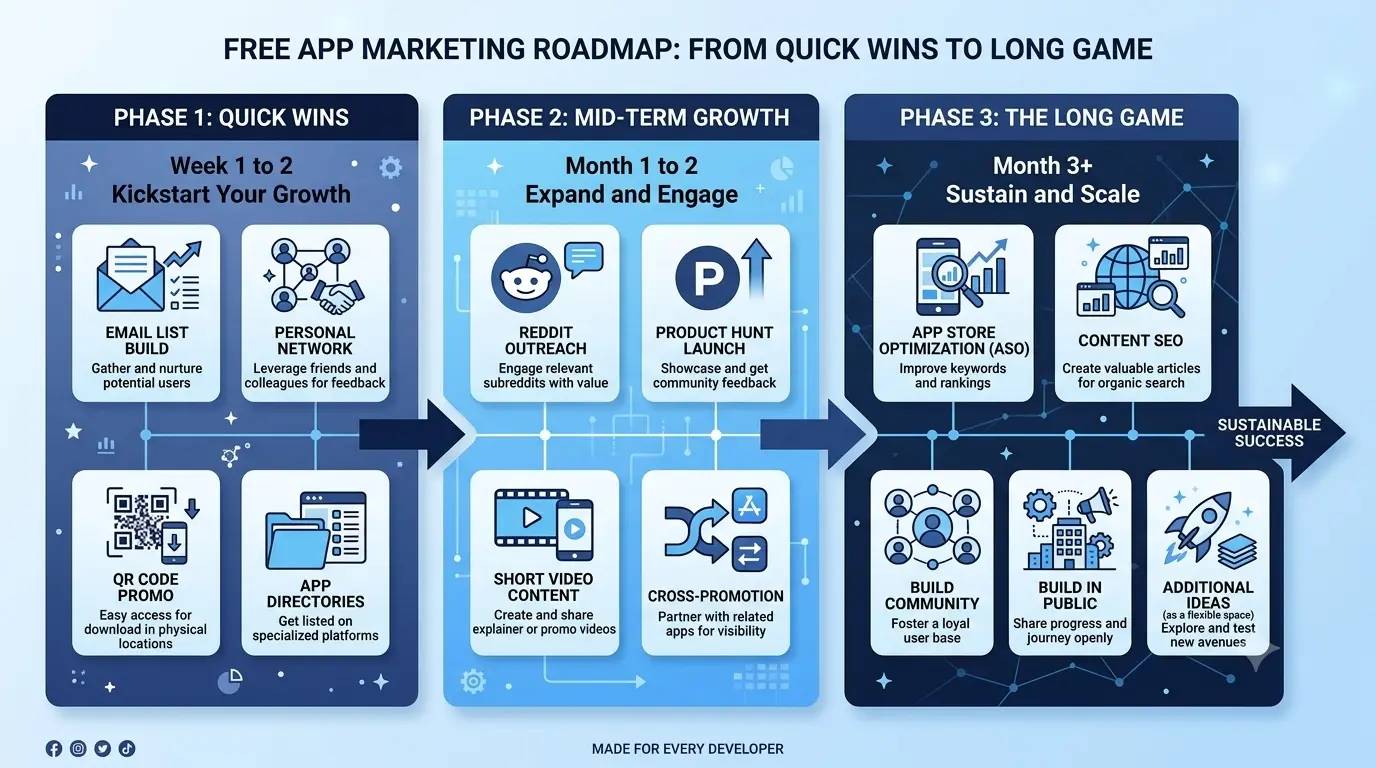
The 13 Ideas at a Glance
Idea | Time to See Results | Effort | Compounds Over Time? |
|---|---|---|---|
1. ASO optimization | 2 to 6 months | Medium (one-time + ongoing) | Yes, heavily |
2. Reddit community | 1 to 4 weeks | Medium (relationship building) | Yes |
3. Product Hunt launch | 1 to 2 days | High (30 days preparation) | Moderate |
4. Email list building | Immediate on launch | Low to medium (ongoing) | Yes, heavily |
5. Review timing | 4 to 8 weeks | Low (one-time setup) | Yes |
6. Content / blog SEO | 3 to 6 months | Medium (weekly writing) | Yes, heavily |
7. Short video (TikTok) | Days to weeks | Low (screen recording) | Moderate |
8. Cross-promotion | 2 to 4 weeks | Low (one partnership) | Moderate |
9. Niche communities | 4 to 8 weeks | Medium (ongoing participation) | Yes |
10. Directories and PR | 1 to 6 months | Low (one-time submissions) | Yes (SEO) |
11. Personal network | Immediate | Low (personal outreach) | No (one-time) |
12. Build in public | 4 to 12 weeks | Low (weekly writing) | Yes |
13. QR codes | Ongoing | Very low (one-time setup) | Moderate |
A Final Note
I want to be honest about something before you close this article.
Not all 13 of these ideas will work for your specific app. Some of them will be a complete waste of an afternoon. That happened to me with every single one of them at some point. The developer who told me Reddit was useless had posted his app link on day one of joining the subreddit and got immediately removed. The developer who told me Product Hunt changed her business had spent 30 days preparing her launch properly.
The ideas are not magic. The execution is what separates the ones that work from the ones that do not. Pick three of these that feel like a natural fit for your app's audience. Do them properly. Give them 8 weeks. Measure the installs that come from each one. Then double down on what is working and move to the next idea on the list.
And before you start: make sure you have a landing page that your marketing can actually point to. Paste your App Store or Google Play link into Entro and have a professional page live in under 5 minutes. Then go run these ideas. The downloads will follow.
Frequently asked questions
Yes, though it requires more time and patience than paid marketing. The free channels in this guide, ASO, community building, content, short video, cross-promotion, email list building, have all driven real installs for real apps. The trade-off is speed: free channels typically take 4 to 12 weeks to produce meaningful results, while paid ads work immediately. The smart approach is to start free channels on day one and keep them running as paid channels are added later. Free channels compound. Paid channels stop the moment the budget does.
Your personal network and Product Hunt launch produce the fastest results, often within 24 to 48 hours. A well-prepared Product Hunt launch can drive 500 to 1,000 installs in a single day. A personal outreach to 50 people who match your target user can generate 20 to 40 installs the same week. These are not sustainable at scale, but they are the fastest ways to generate your first installs and reviews, which then feed the longer-term channels like ASO and content.
ASO typically takes 2 to 6 months to show meaningful organic ranking improvements. The stores need time to index your updated metadata, interpret user behavior signals from any traffic you drive, and adjust your ranking accordingly. That timeline is why ASO should start on the day you publish your listing, not after you have tried everything else. The compounding nature of ASO means the earlier you start, the earlier the organic installs begin, and they continue indefinitely without additional effort.
Yes, but only if done correctly. The key is community participation before self-promotion. Developers who join relevant subreddits and immediately post about their app get removed and banned. Developers who participate genuinely for several weeks before mentioning their app have driven hundreds of installs from a single post. The quality of Reddit installs also tends to be high. Users who discover your app through a community discussion they trust arrive with more context and intent than cold paid traffic, and their retention rates reflect that.
App Store Optimization combined with content marketing is the highest-ROI combination for sustainable long-term free growth. ASO captures users who are actively searching for what your app does. Content marketing captures users earlier in their journey, when they are searching for information about the problem your app solves. Both channels compound over time: a top 3 ASO ranking and a page 1 Google ranking both continue producing installs indefinitely without ongoing cost. Building in public on LinkedIn or Twitter/X is the free channel with the most upside for pre-launch growth specifically.
Three things work. First, ask your personal network directly and individually, not in a group message. An individual email to someone you know who fits your target user, asking for honest feedback, converts at a much higher rate than a broadcast message. Second, time your in-app review prompt for the moment of highest user satisfaction, not first launch. Third, respond publicly to every review in the store. Prospective users see your responses and interpret active developer engagement as a trust signal. These three tactics alone took one app I worked on from 3.4 stars to 4.3 stars in 60 days without any paid spend.
If you are comfortable sharing honestly and consistently, yes. Building in public works because authenticity is increasingly rare online and audiences respond to it strongly. The content that performs best is not success stories. It is honest accounts of decisions, mistakes, and lessons. A LinkedIn post about a feature that flopped and what you learned from it will typically outperform a post about a feature that succeeded. If you can commit to one post a week for 3 months, building in public can generate a warm pre-launch audience that no paid campaign can replicate at the same cost.
Written by
Cyrus
Head of Marketing, Entro
Cyrus writes about mobile app marketing, ASO, and conversion optimization. He's spent the last 3+ years helping indie developers and startup founders get more downloads from organic channels, without paid UA budgets.
Before Entro, he ran growth for two consumer apps that together passed 500,000 downloads on the App Store. Most of what he writes comes from mistakes made with his own money first.
Related articles