How to Promote Your Mobile App: 12 Strategies That Actually Work in 2026
Most app developers have a traffic problem. They do not. They have a conversion problem dressed up as one. Here are 12 strategies that actually move the needle in 2026.

Cyrus
I remember the exact moment I realized a great app is not enough.
We had spent months building it. The UI was clean. The features were solid. We hit publish and the result was nothing. Crickets. A handful of downloads from friends and family, then complete silence.
Here is what 2026 looks like from the outside: the Google Play Store is on course to exceed 4 million apps this year. The Apple App Store is projected to reach 2.3 million. And according to data.ai's State of Mobile 2026 report, global app downloads grew just 0.8% year over year while in-app purchase revenue surged 10.6%. That tells you something important. The install economy is maturing. Casual discovery is dying. The apps that grow in 2026 are the ones that earn their way in front of users intentionally.
The good news: global app revenue is projected to reach $600 to $620 billion by the end of 2026 (Appalize, 2026). There is more money being spent inside apps than at any point in history. The opportunity is enormous. You just need a smarter plan to reach your share of it.
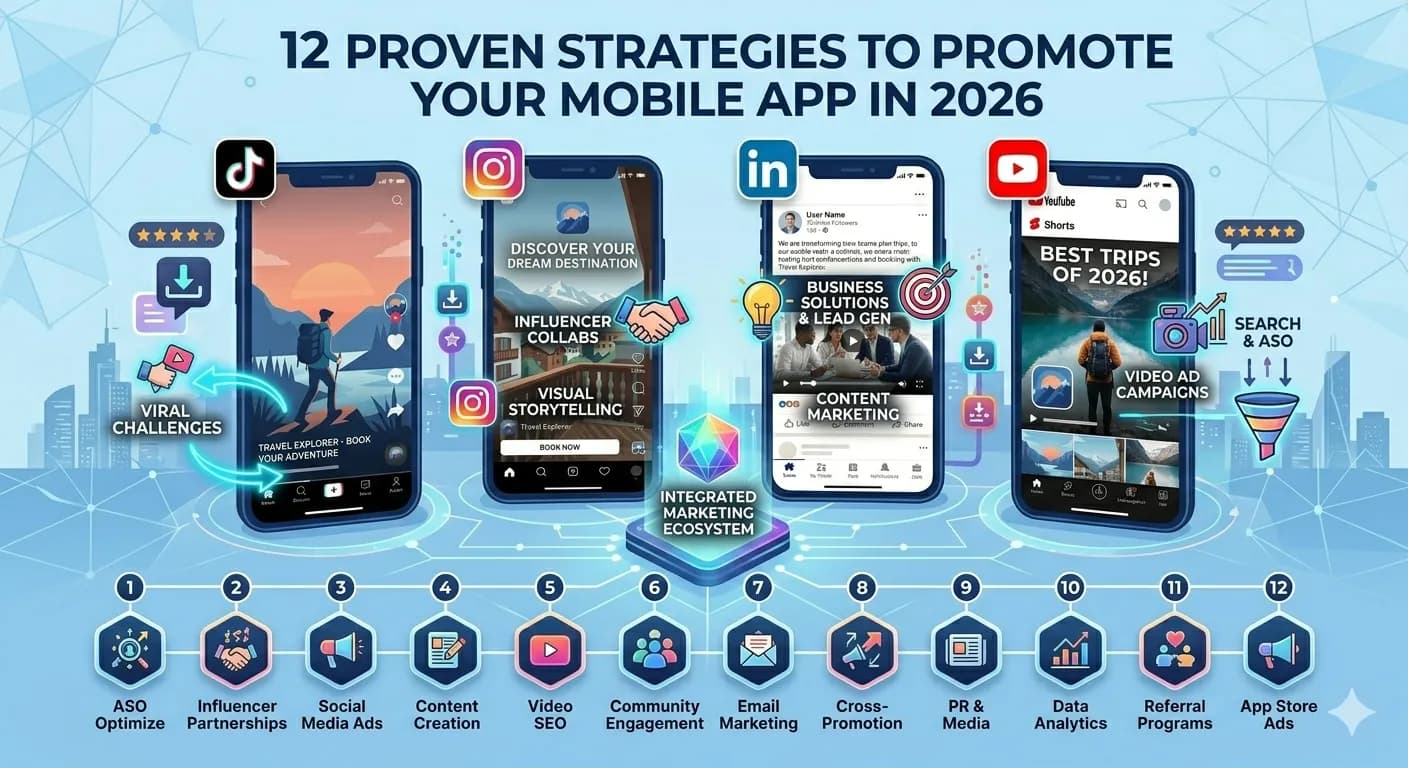
This guide covers 12 proven, actionable strategies to promote your mobile app in 2026. In the order you should do them. Without the fluff.
The App Market in 2026: What You Are Competing In
Before strategy, context. These are the numbers shaping the environment you are promoting into right now.
Metric | 2026 Figure | Source |
|---|---|---|
Global app revenue (projected, end of 2026) | $600 to $620 billion | Appalize / Statista |
Global app downloads (non-game, 2026 forecast) | 190.8 billion | Electroiq / Statista |
Download growth rate YoY (2026) | 0.8% (essentially flat) | data.ai State of Mobile 2026 |
In-app purchase growth YoY (2026) | 10.6% | data.ai / Sensor Tower |
App Store weekly active users | 850 million+ | Apple (2026) |
Google Play apps (projected, 2026) | 4 million+ | Electroiq |
Apple App Store apps (projected, 2026) | 2.3 million+ | Electroiq |
Time spent in apps vs mobile browser | 90% vs 10% | Electroiq 2026 |
Average daily mobile screen time per user | 4 hours 37 minutes | Electroiq 2026 |
Average apps used per month | 30 apps | Buildfire |
Day-1 retention rate (all categories, 2026) | 25.3% | Searchlab / Adjust |
Day-7 retention rate (all categories, 2026) | 11% | Digital Applied 2026 |
Day-30 retention rate (all categories, 2026) | 5.4% | Digital Applied / AppsFlyer 2026 |
That Day-30 retention number is the one that defines everything in 2026. 94 out of 100 users you acquire will be gone within a month. The best promotion strategy in the world cannot fix a product that does not retain. So while this guide covers acquisition, everything here is built on the assumption that your app is worth keeping.
"Downloads are flat. Revenue is growing. The apps winning in 2026 are not acquiring more users, they are extracting more value from the right users. — Jonathan Briskman, Sensor Tower (State of Mobile 2026)
The App Promotion Funnel
Every strategy in this guide fits into one of six stages. Understanding which stage you are investing in at any given moment is how you avoid spreading budget too thin across the whole funnel at once.
Before You Start: Three Foundations Every App Needs in 2026
In 2026, app promotion without preparation wastes money faster than ever. Paid acquisition costs are up 19% year over year on iOS (Digital Applied, 2026). Before you spend anything, check these three foundations.
1. Define your user, not just your demographic
In 2026, the apps that win in paid and organic search are the ones with the clearest understanding of a specific person's specific problem. Not age 25 to 34, fitness enthusiast. Something much tighter. What trigger event leads someone to search for your app today? What alternative are they using right now, and why does it fall short? The tighter your audience definition, the lower your cost per install and the higher your retention.
2. Set your KPIs before you spend a single dollar
Target cost per install by channel (iOS vs Android, paid vs organic)
Day 1, Day 7, and Day 30 retention benchmarks for your category
Average session length and sessions per week
In-app conversion event: the action that predicts a user will stay
Weekly download velocity needed to rank organically in your category
In 2026, both Apple and Google are weighting retention signals more heavily in their ranking algorithms (AppRadar, 2026). This means your KPIs and your promotion strategy are more tightly linked than ever before. An app with strong Day 7 retention will now rank above a competitor with more raw downloads but weaker engagement.
3. Build your landing page before you promote anywhere
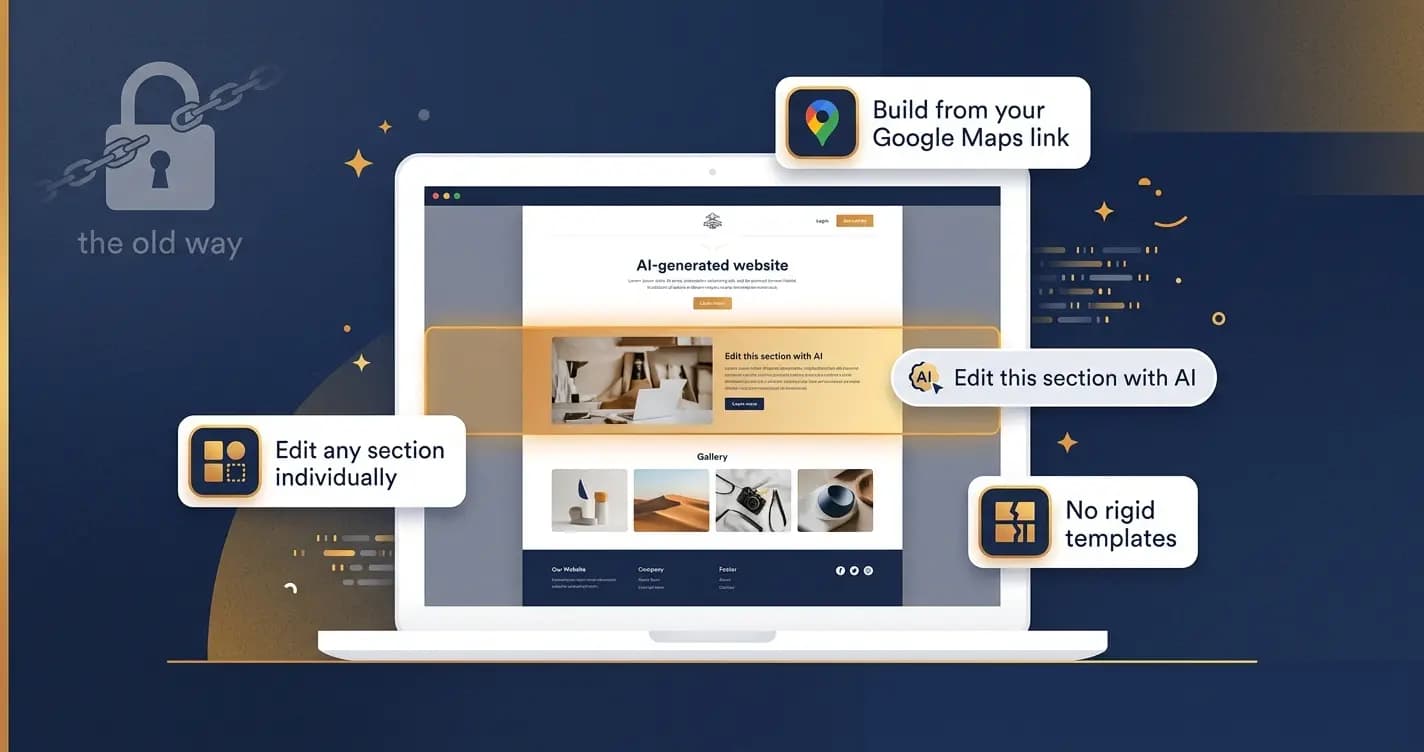
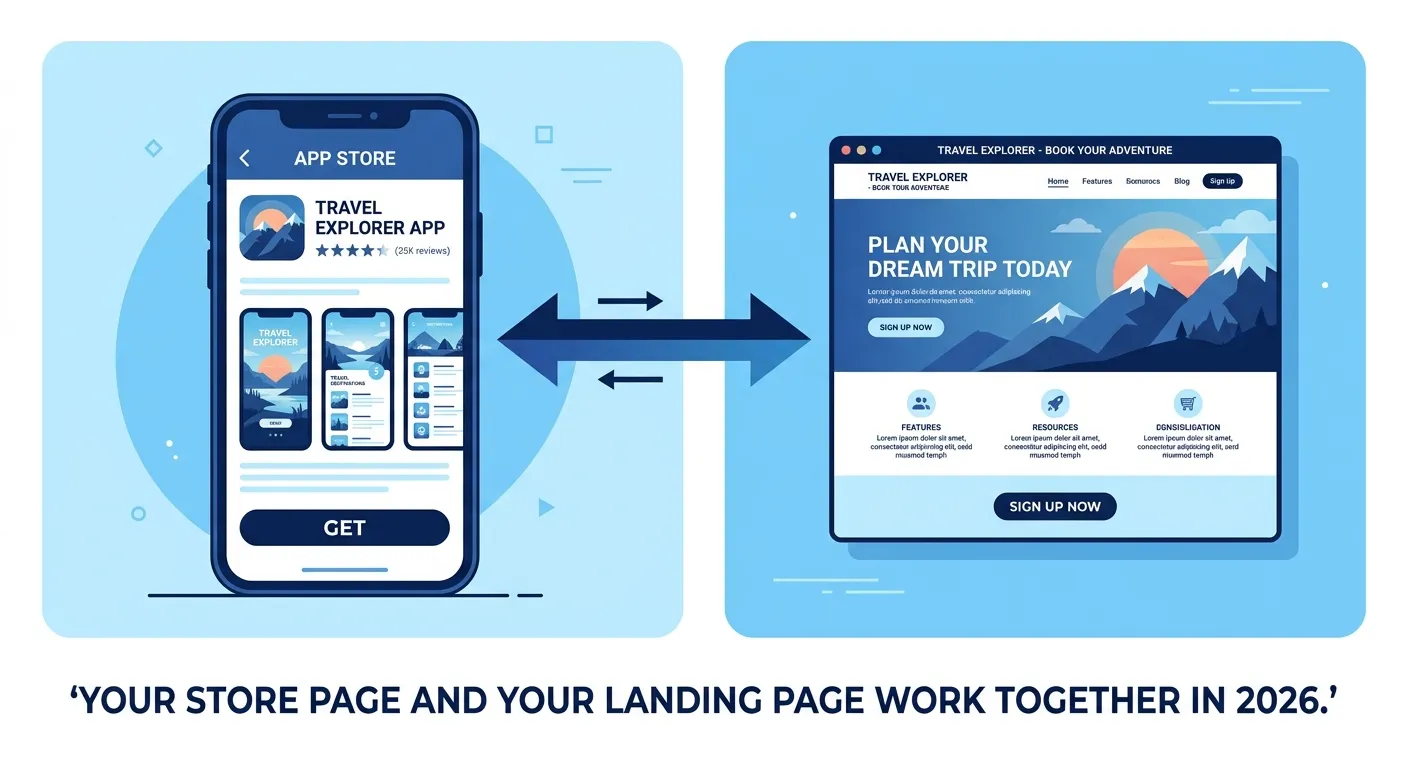
Your app store page belongs to Apple or Google. A dedicated landing page belongs to you. In 2026, with paid CPI up significantly and organic discovery getting harder, having a surface you fully control is not optional. Generate a mobile app landing page with Entro by pasting your App Store or Google Play link. It creates a professional page in seconds so you can start collecting pre-launch emails, running paid traffic, and building SEO equity from day one.
Strategy 1: App Store Optimization (ASO)
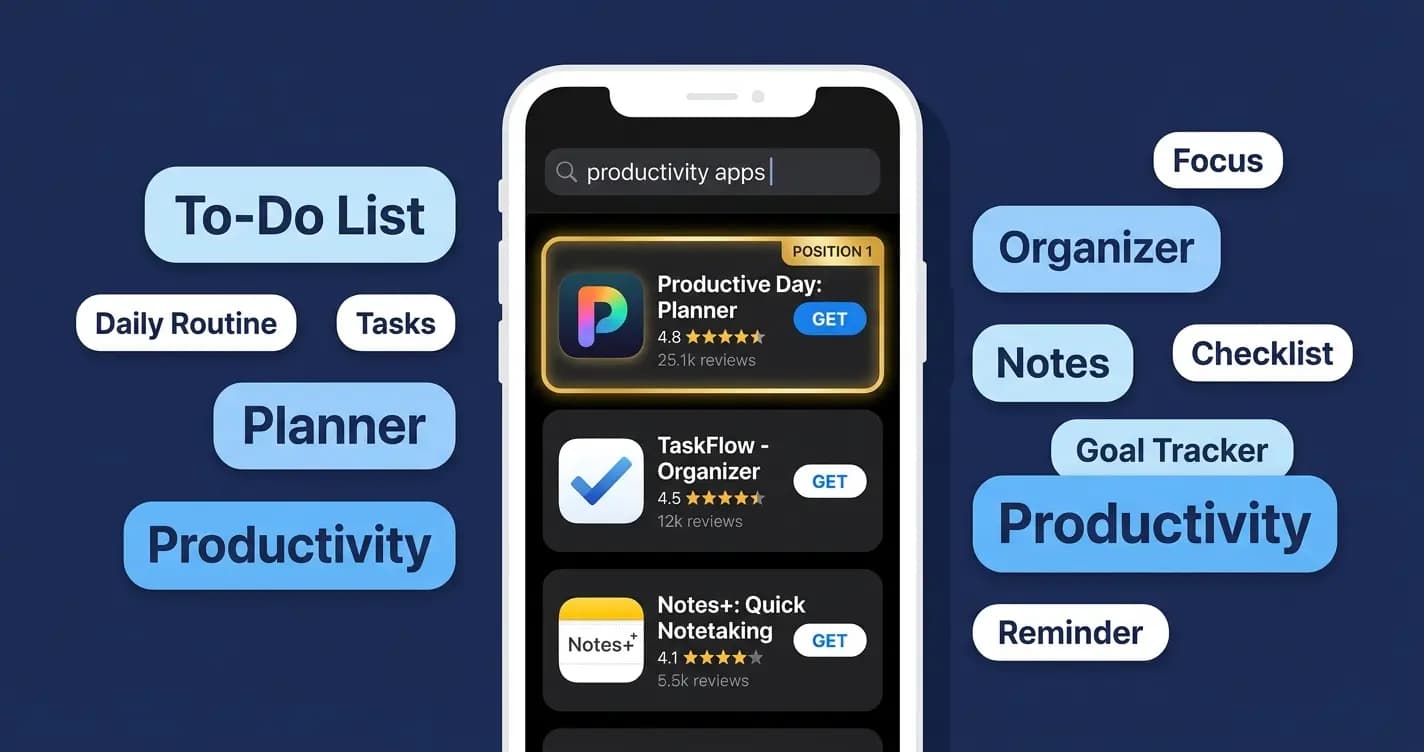
ASO is how you rank inside the App Store and Google Play without paying for every install. In 2026 it is more important and more competitive than it has ever been.
Search drives 65% of iOS app discovery and 58% on Google Play (Digital Applied ASO Statistics 2026). That is the largest single acquisition channel on both platforms, bigger than ads, bigger than browse, bigger than referrals. And in March 2026, Apple added more paid ad slots to search results, pushing organic listings lower on the screen. That makes the top 3 organic positions more valuable than they have ever been. Apps ranked 1 to 3 receive 4.6x the daily organic installs of ranks 8 to 15, and 11.2x the installs of ranks 16 to 30 (Digital Applied, 2026).
A second 2026-specific shift: both stores are now weighting engagement and retention metrics alongside keyword relevance in their ranking algorithms. Optimizing your listing is necessary but not sufficient. You also need users to stick around after they install.
What to optimize in 2026
Element | What to Do in 2026 | Impact |
|---|---|---|
App Title | Primary keyword naturally included. Keep it under 30 characters. | Very High |
Subtitle / Short Desc. | Core value prop plus a secondary keyword. First 80 characters matter. | High |
Long Description | Benefit-led copy with keywords in the first 3 lines for Play Store indexing. | Medium-High |
Screenshots | First screenshot must communicate value in under 2 seconds. Add text callouts. | Very High |
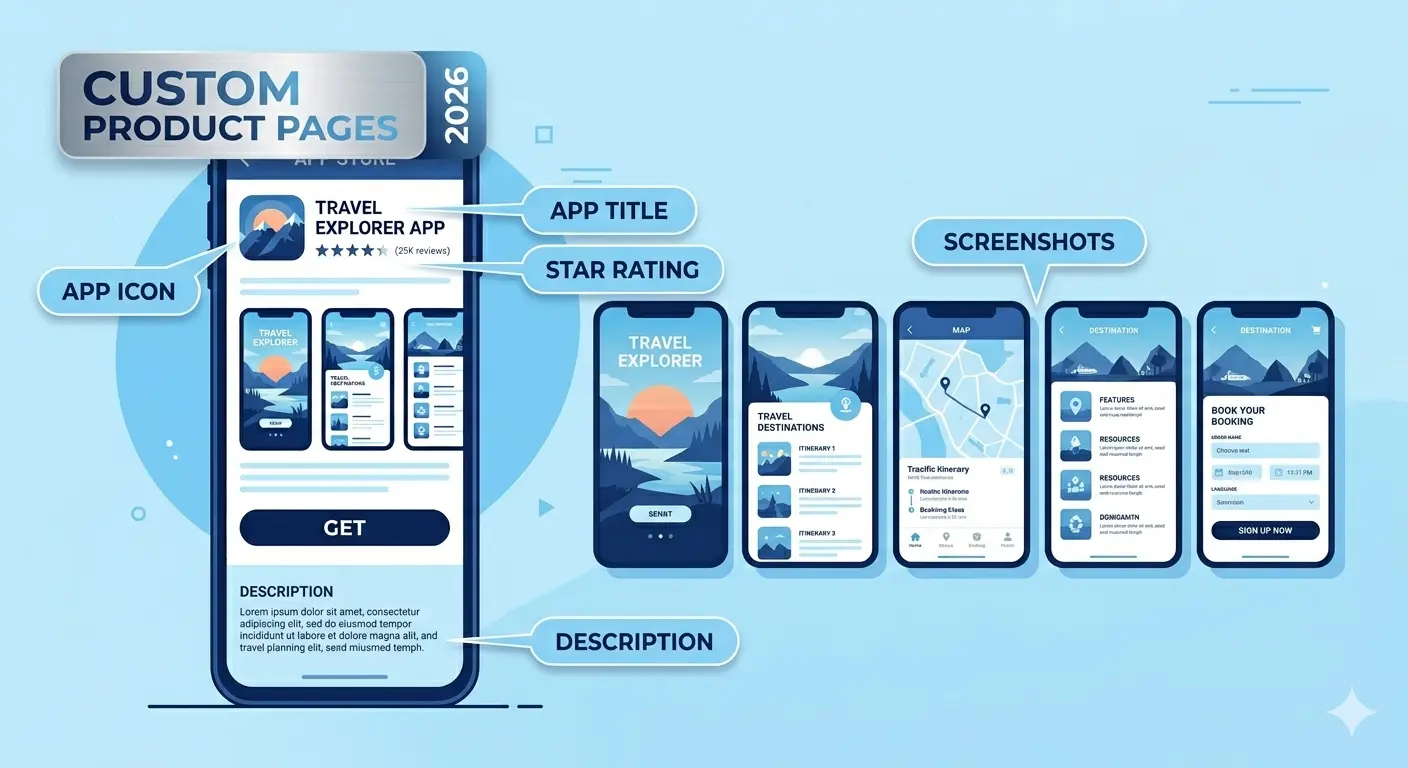
Custom Product Pages | In 2026, CPPs now work for organic search on iOS. Up to 70 per app. Use them. | High (new in 2026) |
Preview Video | 15 to 30 seconds. Hook in the first 3 seconds or users scroll past. | High |
App Icon | Test multiple variants. A/B testing icon impact on CVR is now standard. | High |
Ratings and Reviews | Apps rated 4.5+ show 60% higher CVR than apps rated below 4.0 (AppTweak, 2026). | Very High |
2026-specific ASO actions
Set up Custom Product Pages for your top 5 organic keywords. In 2026, different users searching different terms now see different screenshots organically. This is a CVR game-changer that most developers are still ignoring.
Both stores are now factoring app stability and update frequency into rankings more visibly than before. Ship updates regularly, even small ones.
Localize your listing for your top 3 non-English markets. Localized listings average 26% more downloads per market, and the localization tooling in both consoles is now fast enough that there is no excuse not to do this.
Track competitor keyword moves monthly. AppTweak or AppFollow. In a flat-download environment, keyword market share is a zero-sum game.
Strategy 2: Build a Dedicated App Landing Page
With iOS CPI now averaging $5.84 in Q1 2026 (Digital Applied, 2026), every channel you can own without paying per click has compounding value. A landing page is the highest-leverage owned surface you have outside the app itself.
Your app store page is controlled by Apple and Google. They decide what gets shown, in what order, and who sees it. Your landing page is yours. You can drive any traffic source to it, A/B test headlines, collect emails, run retargeting, and build organic search rankings for keywords that the app stores do not serve.
What a high-converting app landing page needs in 2026
A headline that names the problem you solve, not your app name
A short demo video or GIF showing real in-app moments, not a marketing animation
Social proof: your app store rating, number of downloads, and 2 to 3 short user quotes
Download buttons for both App Store and Google Play, above the fold
An email capture for users who are not ready to download today
Page load under 2 seconds. Each additional second costs 7% of conversions on mobile
The fastest route here is Entro (entro.work). Paste your App Store or Google Play URL and it generates a clean, conversion-optimised landing page automatically. No design work, no developer needed. You go straight from link to live page.
Strategy 3: Social Media Marketing
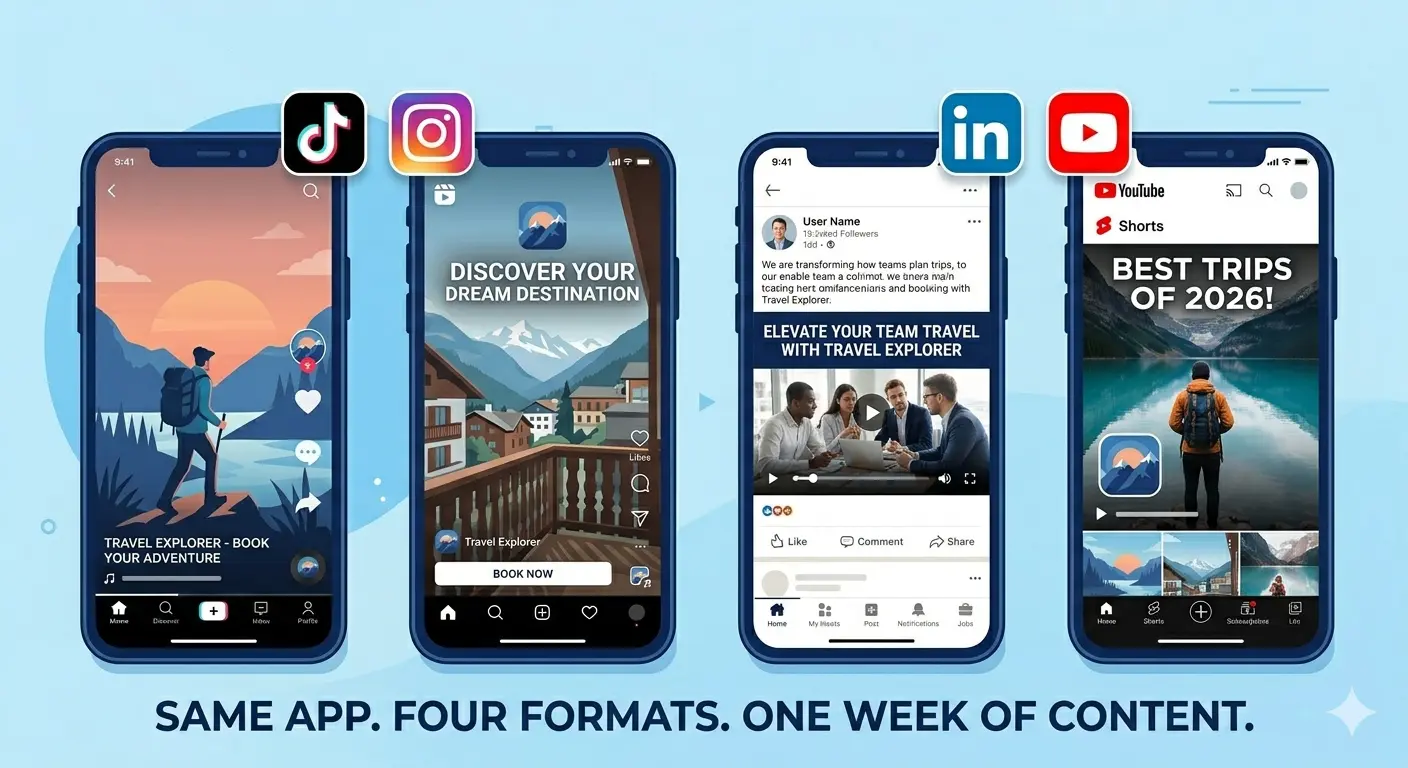
In 2026, short-form video dominates. TikTok was the most downloaded app globally in 2025 and into 2026 with 730 million downloads (data.ai). Instagram Reels and YouTube Shorts are the second and third most-watched short video formats. If your app promotion does not include video, you are leaving the highest-engagement format on the table.
The key is not posting everywhere. It is choosing the right platform for your specific audience and creating content that feels native to that platform, not repurposed from somewhere else.
Match platform to app type in 2026
App Category | Best Platform in 2026 | Best Format |
|---|---|---|
Consumer / lifestyle | TikTok, Instagram | Short video, native demos, UGC reposts |
Productivity / B2B | LinkedIn, Twitter/X | Tip threads, tutorial posts, case studies |
Gaming | TikTok, YouTube, Twitch | Gameplay clips, challenge participation |
Health and fitness | Instagram, Pinterest | Transformation content, routine demos |
Finance and utility | LinkedIn, Twitter/X | Data insights, explainer threads |
Kids and family | Facebook, Pinterest, YouTube | Educational clips, parent testimonials |
What works on social in 2026
30-second screen recordings of your app solving a real problem. No script, no voiceover needed.
User testimonial clips. Ask your best users to record a 15-second voice note or video. Repurpose it.
Behind-the-scenes content. In 2026, audiences trust founders more than brands. Show who built this.
Trend participation. Use trending audio and formats on TikTok and Reels, even for utility apps.
Problem-first hooks. Start every post with the pain, not the solution. The solution is your app.
Pros | Cons |
|---|---|
Free to start, no minimum ad spend | Algorithm changes in 2026 continue to reduce organic reach |
Short-form video builds trust faster than any ad format | Requires consistent video output, not just occasional posts |
Direct comments give you real user feedback immediately | Attribution from social to install is still imprecise |
Viral sharing can drive installs that no paid budget can replicate | Results are slow to build, 3 to 6 months before real traction |
Strategy 4: Influencer and Creator Marketing
Micro-influencers are the standout paid channel of 2026. While mega-influencer deals and celebrity endorsements dominated earlier years, the data now consistently shows that smaller, niche creators drive better cost per install and higher quality users. According to 2026 benchmarks, the average CPI through influencer marketing sits at $4.20 overall, but micro-influencers in a tight niche routinely deliver $1.50 to $2.50 (Searchlab, 2026).
The reason is simple. A 50,000-follower fitness creator whose audience specifically tracks workouts and nutrition will drive more downloads of a fitness app than a 2 million-follower lifestyle celebrity whose audience is broadly interested in everything.
2026 influencer tier guide
Tier | Followers | Avg. CPI | Best For in 2026 |
|---|---|---|---|
Nano | 1K to 10K | $0.80 to $1.50 | Hyper-niche communities, early adopters |
Micro | 10K to 100K | $1.50 to $2.50 | Targeted audiences, best ROI per dollar |
Macro | 100K to 1M | $3.00 to $5.00 | Broader awareness, higher volume risk |
Celebrity / Mega | 1M+ | $5.00 to $15.00+ | Mass brand awareness, rarely efficient |
Always issue a unique tracking link or promo code. In 2026 you need attribution at the creator level to know what is actually working.
Ask for a 30-day exclusivity clause in your niche if budget allows. A competitor running the same creator one week after you significantly dilutes the impact.
Repurpose top-performing creator content as paid social ads. Creator-style ads consistently outperform branded video ads in 2026 because they look native.
Strategy 5: Content Marketing and SEO
In a world where iOS CPI is up 19% year over year, content marketing has never been a better investment relative to paid acquisition. A blog post that ranks on page 1 of Google for a relevant keyword drives installs for years with zero incremental cost per click.
The strategic shift in 2026: AI-generated content has flooded search results, making genuine first-hand experience the primary differentiator. Google's Helpful Content signals are now heavily weighting EEAT (Experience, Expertise, Authoritativeness, Trustworthiness). Content that shows real product experience, real user results, and real expert opinion is winning over generic keyword-stuffed articles.
Content formats that drive app downloads in 2026
How-to guides solving the exact problem your app addresses. First-hand voice only.
Comparison articles: your app versus well-known alternatives. Honest, specific, data-backed.
Tutorial videos on YouTube optimized for your app's use case keywords.
Case studies with real user data and specific outcomes, not vague testimonials.
App roundups that include your app among 5 to 10 relevant tools. Easy to pitch to bloggers.
Publish everything on your own domain, not Medium or LinkedIn. Every piece of content should link to your landing page or app store listing. In 2026, internal linking between your blog, landing page, and any press coverage is one of the fastest ways to build domain authority without paid spend.
Strategy 6: Paid Advertising
Paid app promotion in 2026 is more expensive and more measurable than ever before. iOS CPI averaged $5.84 globally in Q1 2026, up 19% year over year. Android CPI climbed to $1.92, up 8%. These are not numbers to be afraid of. They are numbers that tell you exactly how good your product and your targeting need to be before you scale.
The 2026 rule: do not run paid ads until you can demonstrate that the users you acquire are staying past Day 7. If you cannot hold users, every dollar in ads is a contribution to Apple and Google's revenue, not yours.
Paid channels and 2026 CPI benchmarks
Platform | Ad Type | Avg. CPI (2026) | Best For |
|---|---|---|---|
Apple Search Ads | Keyword intent targeting | $3.50 to $7.00 (iOS) | High-intent iOS users, subscription apps |
Google UAC | Auto-optimised multi-network | $1.92 avg Android | Android at scale, broad categories |
Meta (FB/Instagram) | Interest and lookalike targeting | $2.00 to $6.00 | Consumer lifestyle and social apps |
TikTok Ads | Short native video | $2.45 avg (Searchlab 2026) | Gen Z and millennial audiences |
YouTube Ads | Pre-roll and in-feed video | $2.50 to $7.00 | Gaming, fitness, education, finance |
2026 paid ad rules
Fix ASO first. In 2026, paid traffic from Apple Search Ads and Google UAC both land on your app store listing. A higher-converting listing directly lowers your blended CPI across every paid channel. AppTweak shows that a 20 to 60% conversion rate improvement on your listing compounds across all paid spend.
Creator-style video ads outperform branded video consistently in 2026. Use your best influencer content as paid creative.
Install Adjust or AppsFlyer before you spend a dollar. SKAdNetwork, Privacy Sandbox, and platform attribution changes in 2025 and 2026 make measurement harder. Use a dedicated MMP.
Target LTV over CPI. A subscription app with $7 monthly ARPU can support a CPI of up to $9 to $11 and still hit a 3:1 LTV-to-CPI ratio at 12 months (Digital Applied, 2026).
Strategy 7: Email Marketing and Pre-Launch Lists
Email is the channel that survives every platform algorithm change, every privacy update, and every cost-per-install inflation cycle. In 2026, while iOS CPI hit $5.84 and TikTok CPMs climbed, the cost of sending an email to someone who opted in remains effectively zero.
The ROI of email marketing averages $36 returned per $1 spent across industries. For apps specifically, a pre-launch email list has a compounding benefit most developers miss: a concentrated burst of early installs from warm leads can trigger the app store algorithm to give you additional organic visibility in your category's New and Noteworthy section.
How to build a pre-launch email list in 2026
Put a coming soon landing page live the day you start building. Not the day before launch.
Offer something specific for signing up: early access, a free premium month, or a feature only early members get.
Submit your coming soon page to BeforeYouLaunch, BetaList, and ProductHunt's upcoming section while still in development.
Partner with one or two newsletters in your niche. A sponsored mention to 10,000 qualified readers beats most paid channels at a fraction of the cost.
Your launch sequence: three emails. Day 1: download link and what to do first. Day 4: one feature shown in real use. Day 10: a direct ask for a review from anyone who has opened the app. Keep every email to four sentences or fewer.
Strategy 8: PR, Press, and App Review Coverage
In 2026, earned media is harder to get and more valuable when you get it. Journalists receive more pitches than ever. AI-generated press releases have trained them to delete anything that reads generic. The bar for what gets covered is higher, which means the reward for clearing that bar is also higher.
A genuine feature in a relevant publication or inclusion in an app roundup can drive thousands of high-quality installs in a single day. These are users who arrived with context, trust, and genuine interest. Their retention tends to be significantly better than cold paid traffic.
How to get press and editorial coverage in 2026
Write a pitch, not a press release. Two paragraphs. The first names the problem your app solves and who has it. The second is why this journalist's readers specifically care today.
Target writers who have covered apps like yours in the last 90 days. Relevance beats reach every time.
Submit to these platforms: Product Hunt (for tech and productivity apps), AppAdvice, 148Apps, Android Authority, AlternativeTo, and relevant subreddit communities.
Include a working build, a demo video link, and high-resolution screenshots in your first email. Never make someone ask for assets.
Time your outreach to a genuine news hook: launch day, a significant update, a user milestone, or a trend your app is directly relevant to.
"Your pitch is not about your app. It is about the journalist's reader, and the one specific way your app changes something in their life. Make the pitch about them."
Strategy 9: Ratings, Reviews, and Word of Mouth
In 2026, 90% of featured apps on the App Store maintain ratings of 4.0 or higher, and apps that improved their rating from 3.6 to 4.2 saw nearly 60% higher conversion rates (AppTweak, 2026). Tap-through-to-install rates average 33.4% on iOS and 27.7% on Google Play. Your rating is one of the few variables that affects both. A half-star difference moves your conversion rate meaningfully.
In 2026, both app stores are also surfacing review sentiment as a quality signal in their ranking algorithms. Negative reviews that go unanswered are now a ranking disadvantage, not just a reputation issue.
How to get more positive reviews ethically in 2026
Trigger the in-app review prompt after a specific success event: completing onboarding, hitting a goal, reaching a milestone, or finishing a key workflow. Not at first launch.
Respond to every review, positive and negative, within 48 hours. In 2026, prospective users read your responses as much as the reviews themselves.
Give users an in-app feedback path before they go to the store. A simple 'Something wrong?' button catches frustration early and redirects it away from public reviews.
Email your most engaged cohort directly, the users who have opened the app more than 5 times in the first week. Ask specifically. Do not blast your entire list.
Word of mouth in 2026 is still the most trusted acquisition channel and the hardest to manufacture. The only reliable trigger for it is building something that genuinely solves a problem better than the alternatives. No strategy in this guide substitutes for that.
Strategy 10: QR Codes, Cross-Promotion, and Offline Channels
In a 2026 environment where digital channel costs keep rising, physical and partnership-based channels offer some of the lowest-cost installs available. They are also systematically underused by app developers who spend all their attention on digital.
Add a QR code to any physical touchpoint: packaging, receipts, business cards, event lanyards, in-store signage, menus, or product inserts. QR code scan rates have been growing consistently since 2020 and are now habitual for most smartphone users.
Cross-promote with complementary apps. In 2026, user acquisition partnerships between apps in adjacent niches are a significant growth channel. A productivity app and a note-taking app share a user. A fitness app and a nutrition app share a user. A direct in-app cross-promotion deal costs you nothing in media spend.
Add your app to every piece of content you publish: email signature, LinkedIn bio, author bylines, podcast show notes, and any guest content you write for other publications.
Build a referral program. Give existing users a genuine reason to share your app. A free month of premium, unlocking a feature, or a credit that compounds with each referral. The best referral mechanics feel like a gift to the referrer, not a sales ask.
"The best marketing doesn't feel like marketing. Tom Fishburne, Founder of Marketoonist
Strategy 11: Localization for Global Markets
In 2026, India remains the single largest app download market in the world (Ripenapps, 2026). Brazil is the fifth largest. Indonesia, Vietnam, and Germany are all growing faster than the US in both downloads and revenue. If your app is English-only, you are invisible to the majority of the global install opportunity.
The localization math is straightforward. Localized app store listings average 26% more downloads per market than English-only listings in non-English-speaking countries. And since app store search is the dominant discovery channel in 2026, a listing in the user's local language ranks significantly better for local search terms than an English listing ever could.
Localization checklist for 2026
App store listing: title, subtitle, description, and keywords, in the local language for each target market
Screenshots and preview video: adapt to show local currency symbols, date formats, and culturally relevant use cases
In-app text, error messages, onboarding copy, and push notification templates
Research dominant local platforms and distribution channels (Line in Japan, WeChat in China, Cafe Bazaar in Iran)
Payment methods: local options matter for conversion in markets where credit card penetration is low
Use AI-assisted localization workflows in 2026. Tools like Lokalise and Phrase have cut localization time by 70% while maintaining quality.
Strategy 12: Community Building and Retention Marketing
In 2026, with Day-30 retention sitting at 5.4% across all categories, the apps that build communities are the ones that defy that statistic. A user who is part of a community around an app has a social reason to return beyond the app's features alone. That social layer is the most defensible retention mechanism available.
Communities also create a promotional flywheel. Members share the app, answer questions from potential users, create user-generated content, and surface product improvements that make the app worth sharing. A well-run community of 1,000 active users will outperform a paid acquisition budget of equivalent value over a 12-month horizon.
The rule that makes or breaks a community in 2026: the community must be about the topic, not about your app. A fitness tracking app should build a community around training goals and personal records, not around update notes and feature announcements. Make the community independently valuable. Your app becomes the natural tool that powers the people in it.
Choosing the Right Strategy for Your Stage
In 2026, with acquisition costs higher than ever, knowing which strategies to run at which stage is as important as the strategies themselves. This matrix maps all 12 against cost and time-to-results so you can sequence them intelligently.
Fig. 2 — 2026 Strategy Matrix. In a high-CPI environment, start in the Quick Wins quadrant and build the Long Game in parallel.
Sources: Searchlab, Digital Applied, AppTweak (2026)
All 12 Strategies: Full 2026 Comparison
Strategy | Cost in 2026 | Time to Results | Scalability | Best Stage |
|---|---|---|---|---|
1. ASO | Low (free to implement) | 2 to 6 months | Very High | Pre-launch + ongoing |
2. Landing Page | Low (minutes with Entro) | Immediate | High | Pre-launch |
3. Social Media | Free to low | 3 to 6 months | Medium | Early growth |
4. Influencer | Medium (micro) to High | 1 to 4 weeks | Medium | Launch + growth |
5. Content / SEO | Low to Medium | 3 to 6 months | Very High | Long-term growth |
6. Paid Ads | High (CPI up 19% in 2026) | Immediate | Very High | Growth + scale |
7. Email | Very Low | 1 to 2 weeks | High | Pre-launch + ongoing |
8. PR / Press | Low to Medium | Varies by timing | Low to Medium | Launch + updates |
9. Reviews | Free | Ongoing | Medium | All stages |
10. QR / Offline | Very Low | 1 to 4 weeks | Low to Medium | All stages |
11. Localization | Medium (faster in 2026) | 1 to 3 months | Very High | Growth + scale |
12. Community | Low (time-intensive) | 6 to 12 months | High | Long-term retention |
A Final Note from the Writer
In 2026, the app market is more competitive, more expensive, and more measurable than it has ever been. Download growth is flat. Paid acquisition costs are up. The stores are weighing retention alongside installs in their ranking algorithms for the first time.
That sounds like bad news. I think it is the opposite. It means the apps that succeed are the ones that genuinely earn their downloads and keep their users. Quantity of installs is no longer the winning metric. Quality of user is. And quality of user is a function of how clearly you define who you are building for, how precisely you reach them, and how well the product delivers on what your promotion promised.
The 12 strategies in this guide are not magic. They are a system. Start with the Quick Wins: ASO, a landing page, your first reviews. Build the Long Game in parallel: content, email, community. Add paid channels once you know your retention holds. Iterate every 30 days based on data, not assumptions.
If you are just starting, the first move is simple. Generate your mobile app landing page with Entro, get your ASO in order, and pick three strategies from this guide to run consistently for the next 90 days. In 2026, consistency beats everything else. The apps that grow are the ones that keep showing up.
Frequently asked questions
It depends entirely on the channel. Paid advertising can drive downloads the same day you launch a campaign. ASO typically takes 2 to 6 months to show meaningful organic ranking improvements. Content marketing usually needs 3 to 6 months before organic traffic builds to a useful level. In 2026, the smartest approach is to layer: use paid acquisition for immediate momentum while building organic channels in parallel. As CPI has risen 19% on iOS this year, the faster you can get organic channels producing, the more your unit economics improve.
Free promotion is viable, it just requires more time investment. The three highest-leverage free activities in 2026 are: ASO (optimize your listing for the keywords your users are searching), community participation (be genuinely useful in subreddits, Discord servers, and Facebook groups where your target users spend time), and building a pre-launch email list starting as early as possible. Product Hunt is still the best single free launch platform for tech and productivity apps. And your own network is underrated. A coordinated push from 200 real connections who share your app authentically can generate the early install velocity that triggers algorithmic visibility in the stores.
ASO combined with a dedicated landing page remains the highest-ROI combination for sustainable organic growth in 2026. ASO captures the 65% of iOS and 58% of Google Play users who discover apps through in-store search. A landing page captures everyone else and gives you a surface you own completely. For faster results, micro-influencer partnerships in your specific niche consistently deliver the best paid CPI in 2026, often $1.50 to $2.50 versus $5.84 average iOS CPI through programmatic. Run both simultaneously.
Paid CPI in 2026 averages $5.84 on iOS and $1.92 on Android globally (Digital Applied, 2026). TikTok Ads currently offer the lowest average CPI at $2.45. The US market commands a premium: iOS CPI in the US runs significantly higher because it generates 42% of global app revenue with only 7% of downloads. Through organic channels like ASO, content, and community, your effective CPI trends toward zero over time. The most efficient 2026 approach is to invest in organic while using paid to fill gaps in acquisition velocity.
In 2026, search drives 65% of iOS discovery and 58% on Google Play. It is the single largest acquisition channel on both platforms. On top of that, Apple added more paid ad slots to search results in March 2026, pushing organic listings lower, which makes ranking in the top 3 positions more valuable than ever. Apps ranking 1 to 3 receive 11.2x the installs of apps ranking 16 to 30. And in 2026, both stores are weighting engagement and retention signals more heavily in their ranking algorithms, meaning good ASO now also requires a product that keeps users coming back.
The fastest approach in 2026 is to use a tool built specifically for this. Entro (entro.work) generates a professional app landing page automatically when you paste your App Store or Google Play link. It handles the design, the download button integration, and the email capture form. You can have a live landing page in under 5 minutes and start driving traffic to it the same day. This matters more in 2026 because paid traffic is expensive and every click that does not convert is money lost. A dedicated, optimised landing page converts significantly better than sending paid traffic directly to your app store listing.
Focus on the strategies that do not depend on social proof first. Start with ASO to get your listing technically optimized. Launch a landing page and build an email list before or at launch. Submit to Product Hunt, BetaList, and relevant app review sites the week you launch. Reach out personally to 50 to 100 people who match your exact target user profile and ask for honest feedback in exchange for early access. Those early installs from people who actually care will generate your first reviews and the retention signal the algorithm needs to start surfacing your app organically. Do not run paid ads until you have at least 20 to 30 reviews and your Day 7 retention is above 20%.
Retention and promotion are the same problem in 2026. Both app stores now weight engagement and retention signals in their ranking algorithms, which means poor retention directly hurts your organic visibility. The three retention levers that compound most with your promotional activity: personalized onboarding that gets users to their first value moment in under 3 minutes, a behavior-triggered in-app review prompt at the moment of highest user satisfaction, and a push notification strategy built on behavioral triggers rather than scheduled blasts. Apps with Day-30 retention above 14% (the subscription app benchmark) can support significantly higher CPI on paid channels and still hit healthy LTV ratios.
Written by
Cyrus
Head of Marketing, Entro
Cyrus writes about mobile app marketing, ASO, and conversion optimization. He's spent the last 3+ years helping indie developers and startup founders get more downloads from organic channels, without paid UA budgets.
Before Entro, he ran growth for two consumer apps that together passed 500,000 downloads on the App Store. Most of what he writes comes from mistakes made with his own money first.
Related articles