7 Best Website Builders for Crafters & Etsy Sellers in 2026
My maker friend was paying Etsy $450 a month in fees on $4,000 in sales. She built her own website alongside her Etsy shop. Six months later, 30% of her orders came through directly at zero commission. Here is what she used and why.

Cyrus
A maker friend of mine sold on Etsy for three years. She was good at it. Over 2,000 sales, a four-point-nine star rating, and a loyal base of repeat buyers who kept coming back for her hand-poured candles.
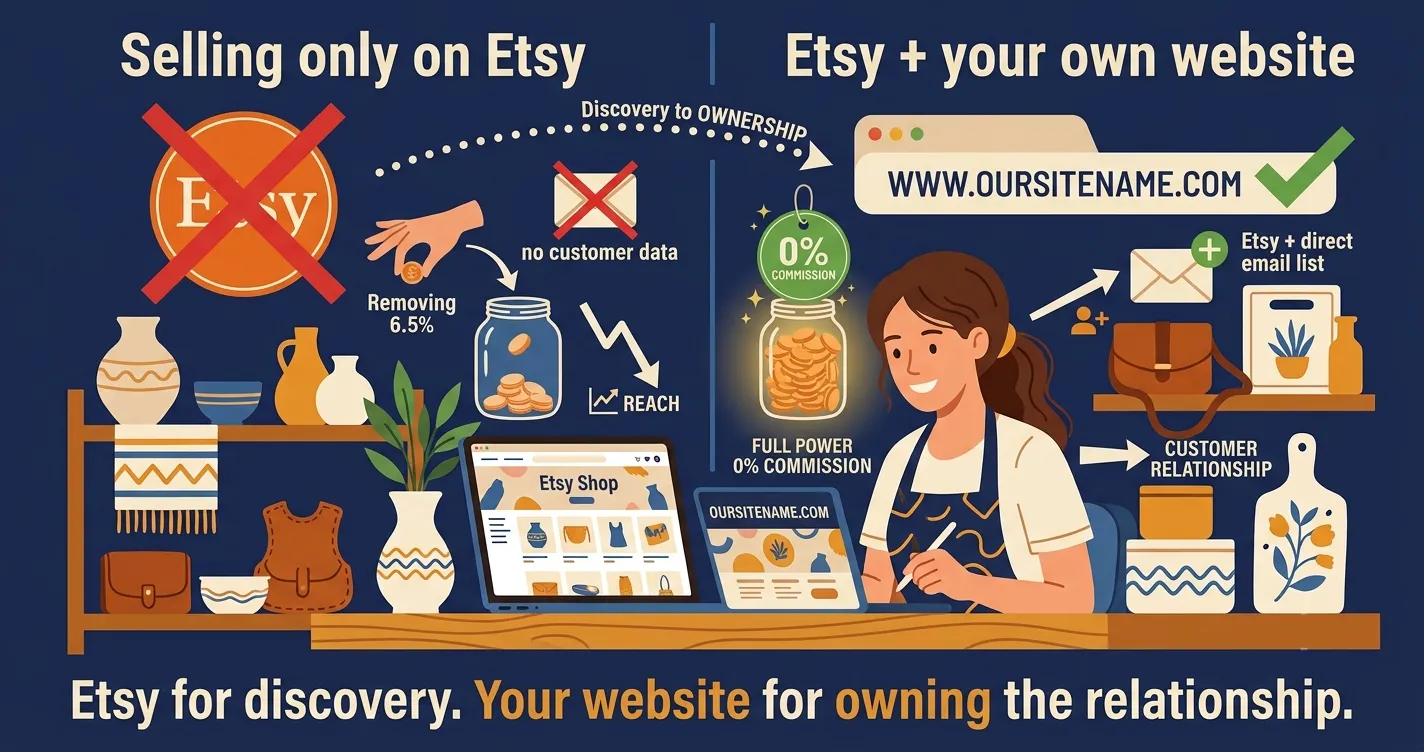
Then she did the maths. Etsy's 6.5% transaction fee, 20 cents per listing, the offsite ads fee she had never opted out of, plus payment processing. On $4,000 of monthly revenue, she was paying roughly $450 to Etsy every month. And she owned none of it. The customer email addresses lived on Etsy's servers. The reviews stayed on Etsy. If Etsy changed its algorithm or its fee structure tomorrow, her business changed with it.
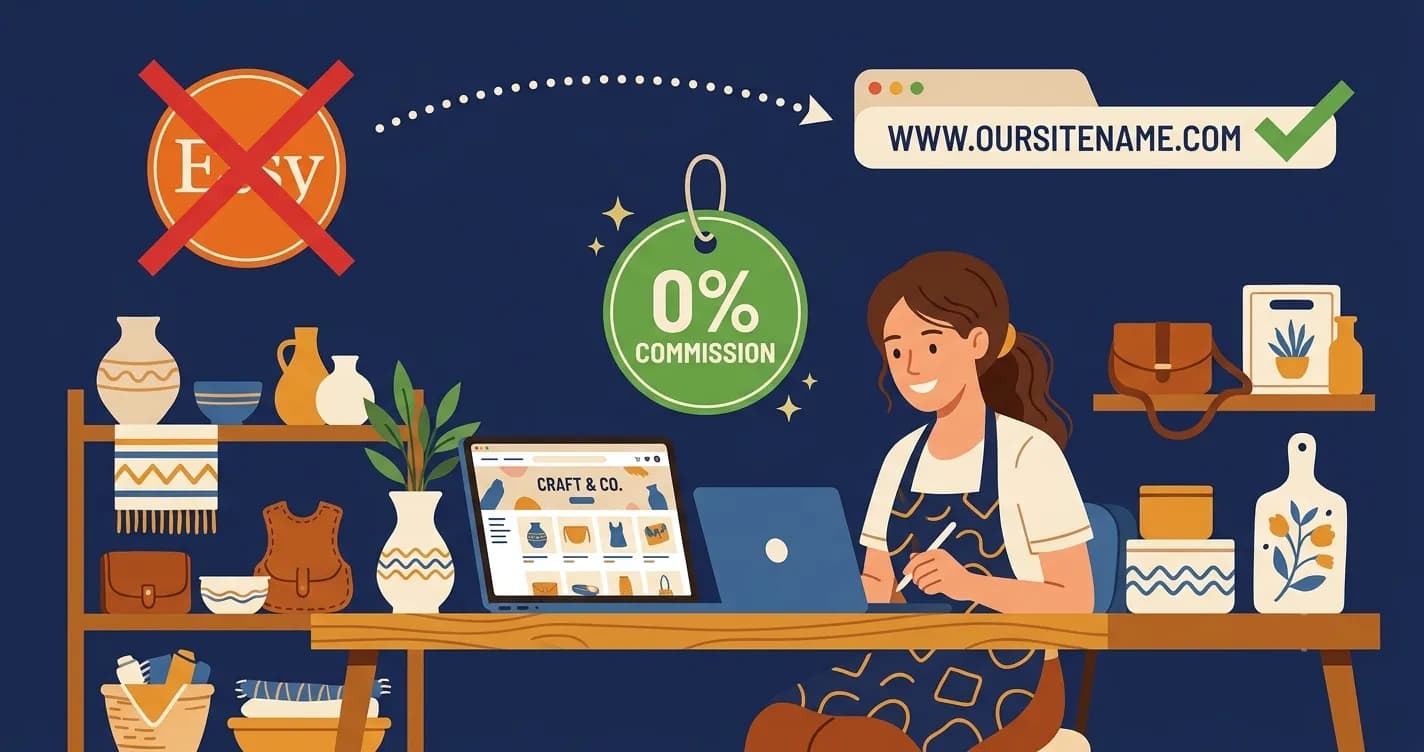
She built her own website. Not to leave Etsy. To own the customer relationship alongside Etsy. Within six months, 30% of her orders were coming through her own site at zero commission. She was sending her Etsy buyers to her mailing list and to her website for repeat purchases. The same revenue, a meaningfully better margin.
In 2026, Etsy has 5.5 million active sellers, down 670,000 from its peak. Many of those sellers are realizing what my friend did: Etsy is excellent for discovery, and your own website is essential for owning the customer. This guide covers 7 website builders that work for crafters and Etsy sellers specifically.
What Crafters Need That Generic Builders Often Miss
Feature | Why it matters for crafters and makers |
|---|---|
Product photography display | Handmade goods sell on how they look. Large images, multiple angles, zoom capability, and gallery layouts matter more than for mass-produced products. |
Commission-free selling | Etsy takes 6.5% plus fees. Every sale through your own site saves that margin. |
Etsy integration or sync | The best companion-site setup lets you manage listings in one place and sell across both channels simultaneously. |
Email list capture | Etsy does not give you buyer email addresses. Your website should capture them so you can market to repeat customers directly. |
Simple inventory management | Most crafters are solo operators. Inventory tools need to be simple enough to manage without a dedicated system. |
Custom domain | Yourname.com builds brand trust. Yourshop.etsy.com keeps the customer on Etsy's platform. |
Shipping management | Calculated rates, multiple carrier options, and label printing reduce fulfilment time for solo makers. |
The 7 Best Website Builders for Crafters in 2026
Shopify — Best for serious Etsy sellers ready to grow beyond the platform
Shopify is the upgrade path for Etsy sellers who have proven their product and are ready to invest in owning their business. You can manage your Etsy listings directly from Shopify, sell across Instagram, TikTok Shop, and your own store from one inventory dashboard, and run abandoned cart emails that recover the buyers who almost purchased. Zero transaction fees if you use Shopify Payments.
Pros | Cons |
|---|---|
Manage Etsy + own store from one dashboard | $29/month is high for low-volume makers just starting out |
Multi-channel: TikTok Shop, Instagram, Pinterest integrated | More complex to set up than Squarespace or Big Cartel |
Abandoned cart recovery on all plans | Blog and content tools less developed for SEO |
Print-on-demand integration (Printful, Printify) for makers | Transaction fees if not using Shopify Payments |
No listing fees on your own store |
Pricing: $29/month (Basic). $79/month (Shopify). 3 months at $1/month trial.
Best for: Etsy sellers doing consistent volume who are ready to own their sales channel fully.
Squarespace — Best for design-forward crafters and makers
Squarespace is the builder that matches the aesthetic sensibility of most handmade product brands. The templates (Paloma, Wells, Flatiron) are editorial, gallery-first, and whitespace-generous in a way that suits the same buyer who saves Etsy listings for the photography. Zero transaction fees on Commerce plans. Etsy import via third-party migration apps.
Pros | Cons |
|---|---|
Most visually impressive templates for handmade and craft products | Less ecommerce depth than Shopify for complex inventory |
Zero transaction fees on Commerce plans | No direct Etsy sync built in (requires third-party tool) |
Unlimited products on all Commerce tiers | More expensive than Big Cartel or Hostinger at Commerce level |
Abandoned cart recovery included | App ecosystem smaller than Shopify for maker-specific tools |
Strong Instagram Shopping and Google integration |
Pricing: Commerce Basic $28/month. Commerce Advanced $52/month. 14-day free trial.
Best for: Design-forward craft brands, candle makers, jewellers, textile artists, ceramics sellers.
Big Cartel — Best free option built specifically for makers and indie sellers
Big Cartel is built for artists and makers selling a small number of handmade products. The free plan covers up to 5 products with a working store, custom domain support, and basic sales reporting at zero cost. No listing fees, no transaction fees. For a crafter just starting out who wants to test a standalone shop before investing in a larger platform, Big Cartel removes every financial barrier.
Pros | Cons |
|---|---|
Free plan: up to 5 products, full working store, zero fees | Limited to 500 products even on the paid plan |
Built specifically for artists, makers, and indie sellers | Less design flexibility than Squarespace or Shopify |
Simple, fast setup with no unnecessary complexity | No abandoned cart recovery |
No transaction fees on any plan | Limited marketing and SEO tools |
Good for low-volume makers who sell seasonal or limited runs | Not suitable for makers planning to scale beyond a few hundred products |
Pricing: Free (5 products). Gold plan $15/month (up to 50 products). Platinum $30/month (500 products).
Best for: Makers with a small product range who want a zero-cost starting point with no fees.
Wix eCommerce — Best all-in-one option for crafters who also need a full website
Wix handles selling alongside everything else a crafter might need from their website: a blog for behind-the-scenes content, booking for workshops, an email newsletter, and a photo gallery showing their work. The zero-transaction-fee ecommerce and large craft-friendly template library make it a natural fit.
Pros | Cons |
|---|---|
Zero transaction fees on all ecommerce plans | Template cannot be changed after the site goes live |
Strong template library including maker and craft-specific designs | Pages not exportable if you leave the platform |
Wix App Market adds workshops booking, email marketing, and more | Less ecommerce depth than Shopify for high-volume sellers |
Multi-channel selling via Facebook, Instagram, Google Shopping | Ascend email marketing is limited compared to dedicated tools |
Wix Ascend for email and customer relationship management |
Pricing: Core $29/month. Business $36/month (full ecommerce).
Best for: Crafters who want an online shop plus a full website including blog, booking, and portfolio.
IndieMade — Best platform built specifically for artists and makers
IndieMade is not a general website builder. It is a platform built exclusively for artists and makers who want to bridge Etsy and a standalone store. The Etsy sync feature lets you import and manage Etsy listings from IndieMade while maintaining both channels. Zero commission on direct sales. At $4.95 to $19.95/month, it is one of the most affordable dedicated maker platforms available.
Pros | Cons |
|---|---|
Built specifically for artists and makers, not a generic tool | Less design flexibility than Squarespace or Wix |
Direct Etsy listing sync and management | Smaller community and support ecosystem than major builders |
Zero commission on all direct sales | Less suitable for makers who want to go far beyond their Etsy audience |
Affordable pricing at $4.95 to $19.95/month | Limited marketing and analytics tools |
Portfolio and shop combined in one maker-focused platform |
Pricing: From $4.95/month (10 products) to $19.95/month (unlimited).
Best for: Makers who want to keep selling on Etsy while building a professional standalone presence.
Hostinger — Best budget option for crafters just starting out
Hostinger's AI website generator creates a starting shop site in under a minute. At $2.99/month with a free domain and SSL included, it is the lowest-cost entry to a professional standalone website for a crafter who is not yet sure whether the investment is worth it. The ecommerce tools are basic but sufficient for a small product range.
Pros | Cons |
|---|---|
From $2.99/month with AI generator, free domain, and SSL | Limited ecommerce depth compared to Shopify or Squarespace |
Fastest route to a live shop at minimum cost | No Etsy sync or integration |
AI content tools for product descriptions | Fewer craft-specific templates |
No transaction fees on ecommerce plans | Renewal pricing significantly higher than introductory rate |
Good starting point for makers testing a standalone store |
Pricing: From $2.99/month (introductory). Check renewal pricing.
Best for: Crafters in their first year who want to test a standalone store at minimum cost.
Pattern by Etsy — Worth knowing about, but not recommended as your primary builder
Pattern is Etsy's own website builder, included for $15/month with your Etsy subscription. It syncs automatically with your Etsy listings and lets you have a custom domain. The reason it appears at the bottom of this list: Pattern's customization options are extremely limited, the templates are basic, and it keeps you entirely within Etsy's ecosystem, which is exactly the dependency a standalone website is meant to reduce.
Pros | Cons |
|---|---|
Automatic Etsy listing sync with no setup | Very limited design customization (10 templates) |
Included for $15/month with Etsy subscription | Keeps you dependent on Etsy's platform |
Simple setup for sellers already managing Etsy | No real SEO control or content tools |
Limited marketing capabilities | |
Cannot capture customer emails independently from Etsy |
Pricing: $15/month add-on to your Etsy subscription.
Best for: Etsy sellers who want the absolute minimum standalone presence. Use a proper builder instead.
Quick Comparison
Builder | Commission fees | Etsy integration | Product limit | Starting price | Best for |
|---|---|---|---|---|---|
Shopify | 0% (Shopify Payments) | Manage from dashboard | Unlimited | $29/month | Volume sellers, growing brands |
Squarespace | 0% (Commerce plans) | Via 3rd party import | Unlimited | $28/month | Design-forward makers |
Big Cartel | 0% | No | 500 (paid) | Free / $15/month | Low-volume, zero-cost start |
Wix eCommerce | 0% | No native sync | Unlimited | $29/month | All-in-one website + shop |
IndieMade | 0% | Native Etsy sync | Unlimited (paid) | $4.95/month | Etsy bridge platform |
Hostinger | 0% | No | Unlimited | $2.99/month | Budget, starting out |
Pattern by Etsy | 0% | Auto-synced | Etsy listing limit | $15/month add-on | Not recommended |
Frequently asked questions
Not necessarily. The most successful maker businesses in 2026 use Etsy for discovery and their own website for repeat customers and direct sales. Etsy's 90+ million buyers are a traffic source worth keeping. But owning your customer list, your reviews, and your commission-free sales channel through your own site makes the overall business significantly more resilient. Build the website alongside Etsy, not instead of it.
Etsy charges a 20-cent listing fee per item, a 6.5% transaction fee on the sale price including shipping, a 3% plus 25-cent payment processing fee, and an optional 12 to 15% offsite ads fee for sellers who qualify. On a $50 sale, you could pay $6 to $8 in combined fees. On your own website with Shopify Payments, Squarespace, or Big Cartel, you pay only the payment processor fee (typically 2.9% plus 30 cents) with no listing or transaction fees.
Yes. Shopify's Etsy integration lets you manage your listings on both platforms from one Shopify dashboard. Inventory syncs across both channels. This is the most common setup for serious Etsy sellers who are building their own brand in parallel: keep the Etsy discovery traffic while building your own customer base through your Shopify store.
Written by
Cyrus
Head of Marketing, Entro
Cyrus writes about mobile app marketing, ASO, and conversion optimization. He's spent the last 3+ years helping indie developers and startup founders get more downloads from organic channels, without paid UA budgets.
Before Entro, he ran growth for two consumer apps that together passed 500,000 downloads on the App Store. Most of what he writes comes from mistakes made with his own money first.
Related articles