7 Best Website Builders for Real Estate Agents in 2026 (IDX, Lead Gen, and CRM Ranked)
An agent I know spent $800 on a new website and got zero leads from it in six months. Good-looking site. Professional headshot, clean layout, contact form. No IDX. Without IDX, her site showed 4 listings. Zillow showed 400. She was not competing. She was invisible.

Cyrus

I know an agent who spent $800 on a new website and got zero leads from it in six months.
It was a good-looking site. Professional headshot, clean layout, a contact form. But no IDX. Without IDX, the site could only show her own active listings, which at any given time was 4 to 6 properties. A buyer who landed on her page searching for homes in her market saw 5 options and closed the tab. On Zillow, that same buyer could browse 400. She was not competing with the portals. She was invisible to the buyers who had already decided to search online.
That is not a fringe scenario in 2026. 97% of home buyers use the internet during their property search (National Association of Realtors, 2025). 78% hire the first agent who responds to their enquiry (Jamil Academy, 2026). And real estate websites with IDX integration receive approximately four times more traffic than those without it (Luxury Presence, 2026). Put those three numbers together and the picture is clear: the right website does not just make you look professional. It generates enquiries while you sleep, captures leads before your competitors even know those buyers exist, and starts the follow-up process automatically.
The NAR settlement in August 2024 changed how buyer agent compensation works. Agents can no longer assume that being associated with a brokerage website is enough. You need your own platform, your own lead capture, your own CRM follow-up. Because when a buyer finds you through your website rather than through your brokerage, the relationship starts with you.
This guide covers 7 real estate website builders in 2026, ranked on what actually generates commissions: IDX quality, lead capture design, CRM depth, and local SEO architecture. Not which one has the prettiest template.
Who this guide is written for: real estate agents and teams evaluating a primary website platform in 2026, including those moving off a brokerage-provided page for the first time, agents upgrading from an under-performing existing site, and teams evaluating a platform switch. This guide does not cover international markets or property management software.
What to Expect From This Guide
The 4 non-negotiables every real estate website must have in 2026
Quick-glance picks box and comparison table so you can find your answer fast
Full reviews of all 7 platforms including who each one is NOT right for
A decision framework matched to your career stage and business goals
7 mistakes that kill real estate websites (and how to avoid them)
Answers to the questions agents ask most before choosing a platform
The 4 Non-Negotiables for a Real Estate Agent Website
You can filter every platform on this list through these four requirements. Miss any one of them and the website will underperform regardless of how much you pay for it.
1. IDX That Renders on Your Own Domain
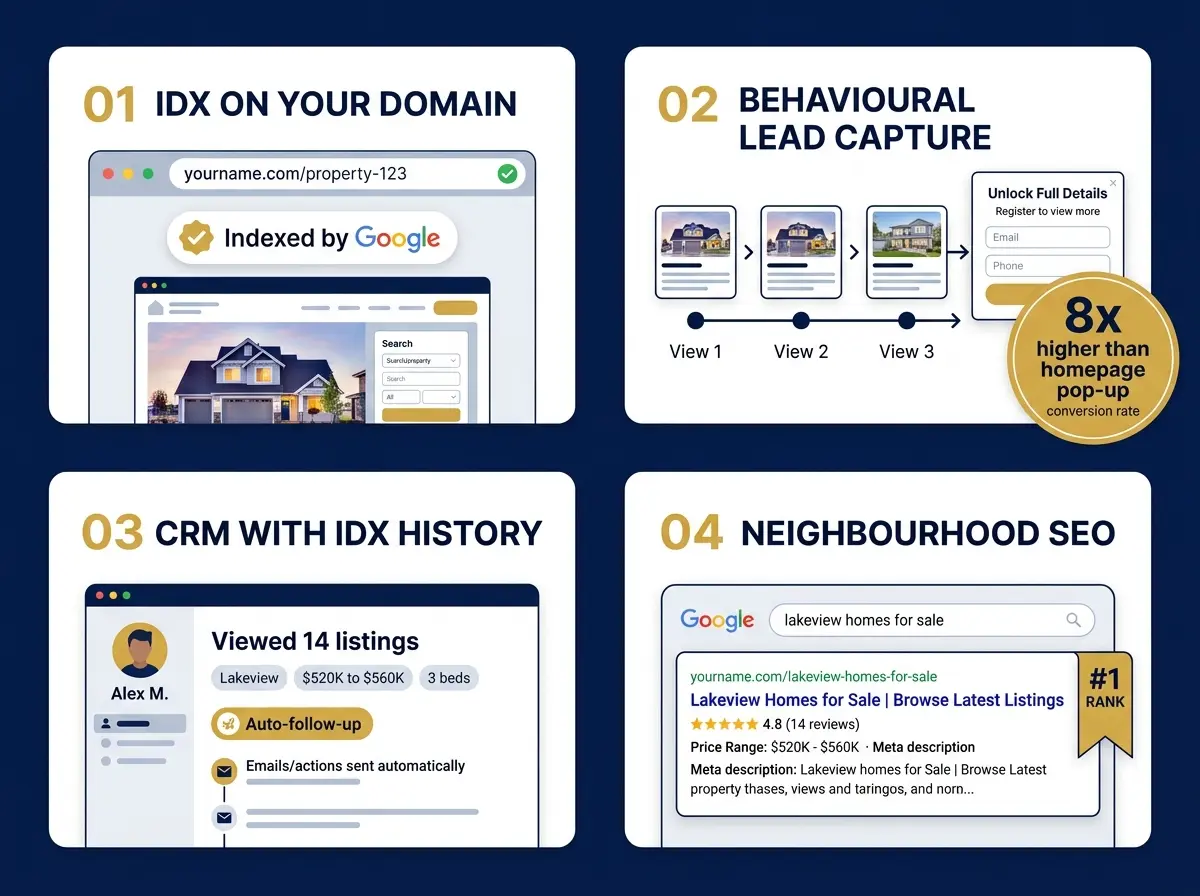
IDX (Internet Data Exchange) is the system that pulls live MLS listings onto your website. But not all IDX is equal. The most important technical detail most agents never hear: IDX listings must render on your own domain (yourname.com/listings), not via an iframe or a subdomain (search.yourname.com).
When IDX is served on your domain, every property page is indexed by Google as a page on your site. You get the SEO credit for thousands of regularly updated, locally relevant pages. When IDX is served via an iframe or subdomain, the SEO value goes to the IDX provider, not to you. Your site stays thin. You stay invisible.
Good IDX: live MLS listings on yourname.com/property-address, indexed by Google, credited to your domain
Bad IDX: a search widget that pulls data into an iframe, or listings that live on search.yourname.com
Red flag to watch for: any platform that serves IDX from a subdomain by default
2. Behavioural Lead Capture (Not a Homepage Pop-Up)
The worst lead capture strategy in real estate is a pop-up that fires the moment someone lands on your homepage. It captures nobody and annoys everyone.
Behavioural lead capture fires after 3 to 5 listing views, when a visitor has demonstrated intent. At that point, a registration prompt offering saved searches and price alerts converts at significantly higher rates than a cold pop-up. Done well, this single feature can multiply your lead volume on the same traffic by five to ten times (Jamil Academy, 2026).
Good: registration prompt fires after 3 to 5 listing views, progressive (email first, then phone)
Good: saved search and price-alert opt-ins give the visitor a reason to register
Bad: homepage pop-up that fires on first page load before the visitor has seen anything
3. A CRM That Knows What Buyers Did on Your Site
Most real estate agents have a CRM. Most real estate agent CRMs do not know that the lead who signed up yesterday viewed 14 listings in the Lakeview neighbourhood, filtered for 3-bed homes under $550,000, and saved two properties before registering. That context changes every follow-up conversation.
The platforms that win on lead conversion in 2026 are the ones where IDX behaviour feeds directly into the CRM record without manual data entry. You call a lead knowing what they searched. You send automated alerts when a new property matches their saved criteria. You know when they returned to the site. That is the difference between a cold follow-up call and a warm one.
4. Local SEO Architecture That Ranks for Neighbourhood Searches
Zillow has 400 listings in your market. You have 6. You will never beat Zillow on volume. But Zillow cannot write a 1,200-word neighbourhood guide about the school catchment area, the new coffee shops, and the median days on market for the past 90 days that your buyer actually cares about. That is depth. Depth ranks.
What you need: dedicated neighbourhood pages with IDX listings, MLS market data, school info, and local content
What you need: clean URL structure (yourname.com/lakeview-homes-for-sale), editable meta titles, schema markup
What kills your rankings: IDX served via subdomain, no editable meta tags, no neighbourhood content infrastructure
Best Real Estate Website Builders at a Glance
Best All-in-One Platform Real Geeks IDX + CRM + AI follow-up, 7,000+ agent teams From $299/month | Best for Local SEO and Brand AgentFire Hyperlocal content strategy, RealTrends top-team standard From $99/month |
Best Entry-Level IDX Site Placester Native IDX at the most accessible price, 4.9/5 rating From $84/month combined | Best for Luxury Markets Luxury Presence Custom editorial design, 100M+ annual platform visitors Custom (typically $400+/month) |
Best for Teams and Brokerages Sierra Interactive Fastest IDX load times, built for multi-agent operations From $500/month | Best Design Flexibility Wix + IDX Broker Full visual control with live MLS search added third-party From $67/month |
Full Comparison Table: All 7 Platforms
Platform | IDX type | CRM | Behavioural lead capture | Neighbourhood SEO tools | Price from | Best for |
Real Geeks | Native, on-domain | Native + AI automation | Yes, 3 to 5 view trigger | Good | $299/month | Lead volume and CRM automation |
AgentFire | Native, on-domain | Integration (BoldTrail etc) | Good | Best on list | $99/month | Local content authority, brand |
Placester | Native, on-domain | Basic built-in | Standard | Good | $59+$25/month | New agents, budget-conscious |
Luxury Presence | Native, on-domain | Integration | Strong | Good | Custom | Luxury and premium markets |
Sierra Interactive | Native, on-domain | Native, robust | Yes, behavioural | Strong | $500+/month | Teams and brokerages, high volume |
Wix + IDX Broker | Third-party, on-domain | Via App Market | Via IDX Broker | Good | $17+$50/month | Design-focused solo agents |
WordPress + IDX | Plugin, on-domain if configured | Via plugins | Via plugins | Best with effort | $60 to $130/month | SEO-serious, technical agents |
Detailed Reviews: Every Platform Tested
Each review below covers the real-world performance picture, not just the marketing page. Every review includes a 'Not right for you if' row so you can rule platforms out quickly as well as in.
Real Geeks
1. Real Geeks Best real estate website builder for lead generation and automated follow-up | |
Real Geeks is the most integrated real estate website platform on this list. When we say integrated, we mean this: a buyer searches your IDX, saves a property, and registers. That registration creates a CRM contact. That contact record shows the address they saved, the price range they filtered, the neighbourhood they searched, and every listing they viewed. An automated email sequence fires within minutes, tuned to a buying timeline that might be 3 months away. You log in to your CRM the next morning and you know exactly who to call and what to say. That is what 15 years of building specifically for real estate agents produces. | |
The AI tools in 2026 are genuinely useful rather than marketing window dressing. The AI follow-up assistant drafts follow-up messages based on the lead's search behaviour. The AI SEO blogging tool generates neighbourhood content drafts that you edit and publish, rather than building from zero. The Facebook ad creation tool connects to your IDX listings and creates retargeting campaigns for people who viewed specific properties. None of these require technical knowledge to use. | |
Real Geeks serves over 7,000 agent teams. That scale means the platform is genuinely stable, the support team has seen most problems before, and the product roadmap is funded. When you are paying $299/month, stability and support quality matter as much as the feature list. | |
Pros | Cons |
IDX, website, and CRM are one system, not three tools that integrate | $299/month is a meaningful commitment for agents below 10 transactions per year |
Behavioural tracking: listing views and saved searches visible in CRM from day one | Website design templates are functional, not visually distinctive |
AI follow-up sequences tuned for real estate buying timelines (weeks to months) | Deep CRM dependency makes platform switching expensive once leads accumulate |
AI SEO blogging and Facebook ad creation built into the platform | Less hyperlocal neighbourhood content infrastructure than AgentFire |
7,000+ agent teams, 15-plus year track record, stable and well-supported |
|
Mobile app for managing leads and responding while on the road |
|
Not right for you if: you are below 8 to 10 transactions per year and the $299/month is not covered by one additional transaction per quarter. Start with Placester and move up when the business justifies it. | |
Our verdict: The closest thing to an automated lead generation system a real estate agent can buy off the shelf. The IDX-CRM connection is what makes it work. Everything else is built on top of that foundation. | |
Pricing: $299/month for solo agent or 2-person team (website + IDX + CRM included). $499/month on 6-month subscription. Annual subscription available. Best for: Agents and teams whose primary goal is maximising lead volume and automating follow-up from one integrated system. | |
AgentFire
2. AgentFire Best real estate website builder for local SEO and long-term market authority | |
AgentFire is built on a specific bet: the agent who becomes the recognised local authority in their market wins the long game. Not the agent with the most listings on their site. Not the agent with the biggest paid ad budget. The one whose name appears in organic search when a buyer types 'homes for sale in Lincoln Park' or 'what is the average home price in Wicker Park.' AgentFire builds the infrastructure for that outcome. | |
The signature feature is the neighbourhood content system. A properly built AgentFire neighbourhood page includes live IDX listings filtered to that area, a current market report auto-populated from MLS data, school information, local lifestyle content, and a lead capture form specific to that neighbourhood. When someone searches that neighbourhood on Google and lands on your page, they get the most useful local resource available. That is what ranks. That is what builds trust before the visitor has ever spoken to you. Zillow and Realtor.com cannot do this. Their pages are thin data pulls. Yours is deep local expertise. | |
Multiple top-ranked agent teams in RealTrends use AgentFire as their primary platform, which is the most credible third-party validation available in real estate web marketing. The honest caveat is timeline: neighbourhood content authority takes 6 to 12 months to build meaningful rankings. If you need leads this quarter, run Google Local Services Ads while the organic strategy builds. If you are thinking 18 months ahead, no platform produces a better return on consistent content investment. | |
Pros | Cons |
Best hyperlocal neighbourhood page infrastructure of any platform tested | Organic SEO results take 6 to 12 months to compound, not this quarter |
Market reports auto-populated from live MLS data, no manual update required | Less CRM automation depth than Real Geeks out of the box |
Neighbourhood content combines IDX, school data, market stats, and lifestyle content | Not available in all MLS markets, check coverage before committing |
Ranked by multiple RealTrends top agent teams, credible third-party validation | Higher ongoing content investment required to maintain rankings |
Native IDX with lead capture on every listing page |
|
Brand-first design philosophy: your name, not the platform's, is the brand |
|
Not right for you if: you need leads in the next 30 days, or you are not willing to invest time in neighbourhood content on an ongoing basis. The platform only returns what you put into it on the content side. | |
Our verdict: The platform for agents who are building a 3-year position in their market, not agents who need a pipeline fix this week. The agents who win on AgentFire tend to have substantially lower lead acquisition costs long-term because their traffic is organic and compounding. | |
Pricing: From $99/month. Contact AgentFire for current plan details and MLS market availability. Best for: Established agents and teams in competitive markets who are committed to local content authority as a long-term lead generation strategy. | |
Placester
3. Placester Best value real estate website builder with native IDX for newer and budget-conscious agents | |
Placester is the clearest entry point to professional real estate web presence in 2026. The 4.9 out of 5 Google rating from over 1,600 verified agent reviews is the most credible quality signal on this list and reflects consistent delivery on what the platform promises: a native IDX-enabled website at a price that makes sense before you are doing 15 to 20 transactions per year. | |
The AI website builder launched in 2026 generates a first draft of your agent website in under 5 minutes. That is not a gimmick: it means an agent who has been putting off building a website because they do not know where to start can have something live and functional the same day they sign up. The concierge service goes further, handling the entire setup for $50/month additional, which is the right option for agents who would rather spend that time in front of clients. | |
What Placester does not do: deep behavioural CRM tracking, AI-powered follow-up sequences, hyperlocal neighbourhood content templates, or the luxury design that a premium market agent needs. It does what a professional IDX website needs to do: it puts you online with live MLS listings, lead capture, and a professional presentation at a price that is defensible at any stage of a real estate career. | |
Pros | Cons |
4.9 out of 5 Google rating from over 1,600 verified agent reviews | IDX priced separately at $25/month on top of base $59/month plan |
Native IDX integration included, no third-party configuration required | CRM is basic, no behavioural tracking from IDX search activity |
AI website builder generates a first draft in under 5 minutes (2026 feature) | No hyperlocal neighbourhood content infrastructure |
Concierge setup service: full build handled for $50/month additional | Design templates less visually distinctive than premium platforms |
Mobile app for lead management on the go |
|
Real estate-specific templates and listing page layouts built in |
|
Not right for you if: you are doing 15 plus transactions per year and lead automation is the bottleneck. At that volume, Real Geeks or AgentFire will pay for themselves faster. | |
Our verdict: The right starting platform for most agents. Not the most powerful platform on the list. The most appropriate one for where most agents actually are when they are evaluating for the first time. | |
Pricing: $59/month (website) plus $25/month (IDX). Total $84/month. Concierge setup available at $50/month additional. AI website builder included on all new accounts. Best for: New agents, part-time agents, and agents in lower-volume markets who need a professional IDX site without enterprise-level cost or complexity. | |
Luxury Presence

4. Luxury Presence Best real estate website builder for luxury and premium market agents | |
Luxury Presence draws 100 million annual visitors and processes 700 million annual interactions across its client base. Those are brokerage and team aggregate numbers, not individual agent metrics, but they reflect the infrastructure quality behind the platform. At the individual agent level, what matters is simpler: does the website look like it belongs in the market you are serving? For a luxury agent presenting to a seller listing a $3 million property, the answer has to be yes before the first meeting. | |
The custom design process is what separates Luxury Presence from every other option on this list. Professional designers build around your brand, your market photography, and your visual standards rather than applying a template. Presence AI handles content generation, marketing automation, and lead nurturing. The IDX integration is designed for luxury listing presentation standards: full-screen property photography, high-resolution image carousels, and property detail pages that match the quality of the homes they represent. | |
The honest financial case for Luxury Presence: one additional listing secured per year because the website elevated your professional presentation at a seller consultation is all the ROI calculation you need. At a $2 million listing with a 2.5% commission, that is $50,000. The platform's annual cost at several hundred dollars per month is covered many times over. The agents who should not use it are those who are not yet in the market where that calculation applies. | |
Pros | Cons |
Custom editorial-quality design built by professional designers around your brand | Custom pricing, typically starting at several hundred dollars per month |
100 million annual visitors and 700 million interactions across client base | Setup involves a design collaboration process, not a same-day self-service launch |
Presence AI for content generation and marketing automation | Less CRM automation depth than Real Geeks for high-volume lead nurturing |
IDX built for luxury listing visual standards: full-screen photography, high-res carousels | Overkill and not cost-effective for agents outside premium price point markets |
Dedicated account management and ongoing support included |
|
Not right for you if: you are not regularly listing or representing properties above $1 million. The cost-to-benefit ratio does not work below that price point and there are better-value options for every other market segment. | |
Our verdict: The most credible visual platform for luxury real estate in 2026. The ROI math is simple: one additional listing per year because the site elevated your presentation in a seller meeting covers the annual cost many times over. | |
Pricing: Custom pricing. Generally starts at several hundred dollars per month. Contact Luxury Presence for current packages. Best for: Luxury agents, boutique brokerages, and premium market specialists where website quality is a direct factor in winning listing presentations. | |
Sierra Interactive
5. Sierra Interactive Best real estate website builder for teams, brokerages, and high-volume operations | |
Sierra Interactive is the platform most agent teams at scale move to when they outgrow Real Geeks. The distinction is in the IDX performance and the team management infrastructure. Sierra is known for producing some of the fastest-loading IDX pages in the industry, which matters for SEO (Google weights mobile page speed in local search rankings) and for user experience (a 3-second load time loses a measurable percentage of mobile visitors before they see a single listing). | |
The team management tools are the strongest on this list for multi-agent operations. Lead routing rules can be configured to distribute leads by neighbourhood, price range, agent specialisation, or round-robin. Each agent has their own CRM view while the team leader or broker has an aggregate view across all agents. Behavioural lead capture is built in with configurable triggers. The platform integrates with all major real estate CRM and marketing tools including BoldTrail, Follow Up Boss, and kvCORE. | |
The price reflects the power: Sierra Interactive typically starts at $500/month or above, which is the right investment for a team doing 50 plus transactions per year but not for a solo agent doing 12. Solo agents who are impressed by what Sierra offers but not ready for the price should look at Real Geeks, which offers a meaningful subset of these capabilities at $299/month. | |
Pros | Cons |
Among the fastest IDX page load times in the industry, beneficial for SEO and UX | Starting price around $500/month, not appropriate for solo agents at most volume levels |
Team management: lead routing by neighbourhood, price, specialisation, or round-robin | Setup complexity higher than Real Geeks or Placester |
Aggregate broker view plus individual agent CRM views in one system | Overkill for teams below 20 to 30 transactions per year |
Behavioural lead capture with configurable triggers built in | Design templates functional rather than visually distinctive |
Integrates with Follow Up Boss, BoldTrail, kvCORE, and major real estate CRMs |
|
Not right for you if: you are a solo agent or a small team doing under 25 to 30 transactions per year. Real Geeks at $299/month covers most of what Sierra does at a fraction of the cost for that volume. | |
Our verdict: The team and brokerage standard for high-volume real estate operations in 2026. The IDX speed, lead routing, and team management tools are the strongest available at scale. Worth the price for the volume of operation it is designed for. | |
Pricing: From approximately $500/month. Contact Sierra Interactive for current pricing based on team size and market. Best for: Agent teams doing 40 plus transactions per year and brokerages who need multi-agent IDX, lead routing, and an aggregate management view. | |
Wix + IDX Broker

6. Wix + IDX Broker Best real estate website builder for design-focused agents who want visual control | |
Wix is the most flexible general website builder available and IDX Broker is the most widely used third-party IDX solution in the US market. Together they give you the design freedom of a premium website builder combined with live MLS listing search, registered user management, saved searches, and property alert emails. The visual output is more distinctive than any dedicated real estate platform, because you are not constrained by real estate-specific templates. | |
The practical case for this combination is an agent whose personal brand and visual identity are meaningful competitive advantages. An agent in a walkable urban neighbourhood who is known for lifestyle content, personal brand, and a distinctive aesthetic will look more like themselves on a Wix site than on any real estate platform template. The App Market adds CRM integration (Wix connects with HubSpot, Salesforce, and Zoho), email marketing, and chat without switching platforms. | |
The operational reality: support is split between Wix and IDX Broker when something goes wrong. You are managing two separate billing relationships. And IDX Broker's embed quality on Wix requires careful configuration to look like it belongs on your site rather than like a third-party widget dropped in. Get the IDX setup right before you go live, because it is the most visible element on the site and the one that most affects lead quality. | |
Pros | Cons |
Most visual design flexibility of any combination on this list | Support is split between Wix and IDX Broker, no single contact when issues arise |
IDX Broker: widely used IDX with MLS coverage across most US markets | IDX embed quality requires careful configuration to look native on the site |
Wix App Market for CRM, email, and chat integration without platform migration | No built-in real estate CRM: lead data management requires a separate tool |
Lower combined cost than dedicated real estate platforms at a similar feature level | More setup work than dedicated real estate platforms for equivalent features |
Wix Bookings visible in Google Maps for local service discovery (2026 update) |
|
Not right for you if: you are not comfortable managing two connected platforms, or you need to be live and generating leads within a week. Use Placester for speed, Wix for design. | |
Our verdict: Right for design-conscious agents who want a visually distinctive site and live MLS search at a mid-range price. The visual output at this price point is the strongest on the list. The setup complexity is the honest trade-off. | |
Pricing: Wix from $17/month plus IDX Broker from $50/month. Combined from approximately $67/month. Best for: Solo agents who prioritise brand aesthetics and are comfortable managing two connected tools for their web presence. | |
WordPress + IDX Plugin (IDX Broker or Showcase IDX)
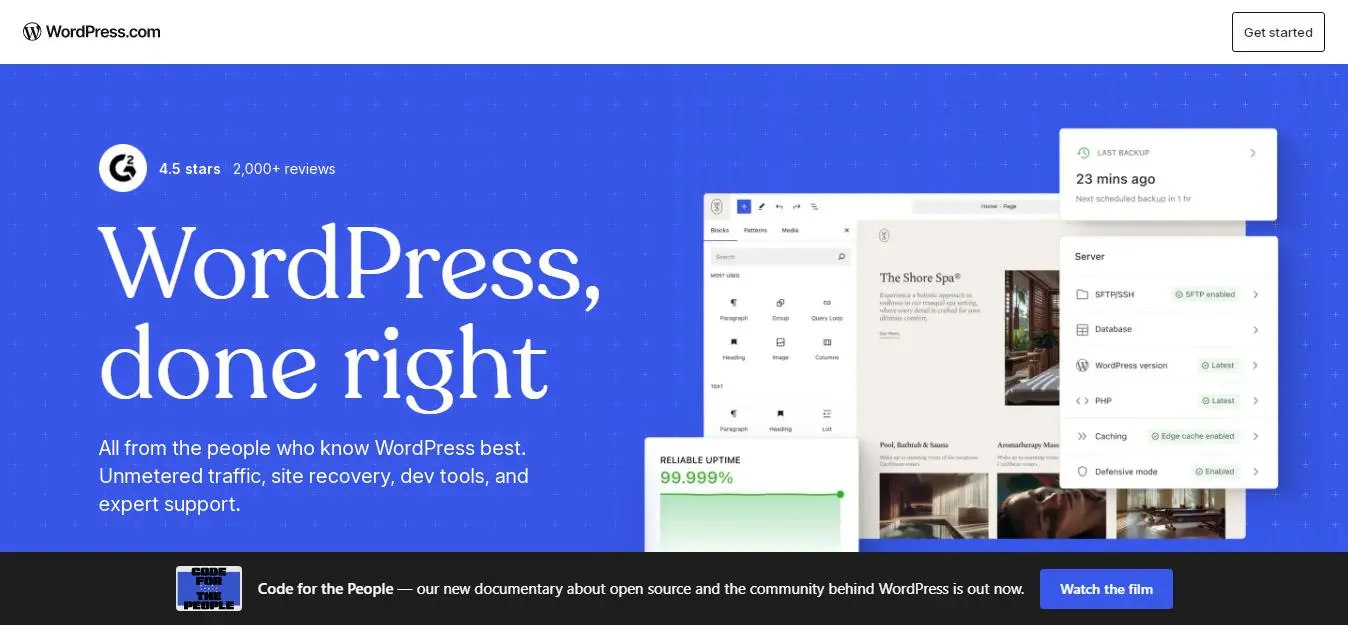
7. WordPress + IDX Plugin (IDX Broker or Showcase IDX) Best real estate website builder for maximum SEO control and data ownership | |
Self-hosted WordPress with a dedicated IDX plugin is the highest-ceiling real estate website option on this list. The SEO control is genuinely different from any hosted platform. You control every meta tag, every URL structure, every schema markup, and every canonical URL. With Yoast or Rank Math installed, every neighbourhood page, every listing page, and every blog post is configured exactly as you want Google to read it. No hosted platform gives you this level of control because they are managing infrastructure for thousands of users simultaneously. | |
The key technical requirement that most guides skip: when you set up IDX on WordPress, configure it to serve listings on your own domain with clean, crawlable URLs. Listings at yourname.com/address-city-state are indexed by Google and credited to your site. Listings served via subdomain or iframe are not. This configuration choice is what determines whether your IDX generates SEO value or does not. It is the most important setup decision in real estate web marketing and it is not enforced by default. Ask your IDX plugin provider explicitly whether listings are served on-domain before going live. | |
Data ownership is the other distinctive advantage. Your contact database, your content, your lead history, your CRM integrations are all on infrastructure you control. You can move hosts. You can switch IDX providers. You can export everything. On a proprietary platform, you are tenants. On WordPress, you own the building. That matters most if you ever change platforms, which every agent eventually does. | |
Pros | Cons |
Best organic search architecture when IDX is configured correctly on-domain | Most complex setup on this list, requires technical knowledge or developer investment |
Full control over every meta tag, URL, schema markup, and canonical URL | IDX on-domain configuration requires explicit setup, not automatic by default |
Complete data ownership: contacts, content, and history are fully portable | Security, updates, and performance management are entirely your responsibility |
No monthly platform fee beyond hosting and plugin costs | Support is fragmented across hosting, IDX plugin, theme, and additional plugins |
Can switch IDX providers or hosts without losing data or rebuilding from scratch |
|
Not right for you if: you are not willing to invest in proper technical setup, or you do not have a developer relationship for the initial build. A misconfigured WordPress IDX site is worse for SEO than a properly configured hosted platform. | |
Our verdict: The right choice for agents and brokerages who treat organic search as a primary lead source and want complete control over the platform long-term. The difficulty of building it correctly is also what makes it difficult for competitors to replicate once established. | |
Pricing: Hosting from $10 to $30/month. IDX plugin from $50 to $100/month. Theme from $0 to $100/year. Developer setup variable. Best for: Established agents and brokerages with technical resources who want the strongest long-term SEO position and complete data ownership. | |
7 Mistakes That Kill Real Estate Websites (and How to Avoid Them)
Mistake | What it costs you | How to avoid it |
IDX served from a subdomain or iframe | Every listing page earns SEO credit for the IDX provider, not for you. Your site stays thin in Google's eyes indefinitely. | Confirm with your platform or IDX provider that listings render on your own domain with crawlable URLs before you go live. |
Homepage pop-up registration gate | Visitors who have not seen anything yet have no reason to register. You drive away the majority of your traffic before they see a single listing. | Configure behavioural lead capture to fire after 3 to 5 listing views, when the visitor has demonstrated intent. |
Relying solely on the brokerage-provided website | Your brokerage page disappears the day you change firms. It cannot rank for your name. It cannot rank for your market. It is not yours. | Build your own platform from day one. Your domain, your CRM, your content. These travel with you. |
No neighbourhood content pages | You have IDX listings but no topical authority for the neighbourhoods you serve. Google has no reason to rank you for neighbourhood searches over Zillow. | Build dedicated neighbourhood pages with local market data, school information, and area content on your domain. |
Not following up within 5 minutes of a new lead | 78% of buyers hire the first agent who responds (Jamil Academy, 2026). A lead that waits 4 hours is a lead your competitor has already called. | Configure automated follow-up to fire within minutes of lead registration. Real Geeks and Sierra Interactive do this natively. |
Choosing a platform based on design alone | A beautiful website with no IDX and no lead capture is a digital brochure. It does not generate business. | Evaluate IDX quality, lead capture behaviour, and CRM integration before you consider how the homepage looks. |
Never publishing neighbourhood or market content | Your IDX gives Google listing pages. Your content gives Google authority. Without content, you are invisible for anything other than your exact address search. | Publish one neighbourhood guide or market report per month. AgentFire and Real Geeks both have tools to accelerate this. |
Which Platform Is Right for You
Use this to find your answer based on where your business actually is, not where you want it to be.
Your situation | Best platform | Why |
New agent, first website, need to be live this week | Placester | Native IDX at $84/month total, AI builder generates a first draft in 5 minutes, 4.9 star rating from 1,600+ agents |
Established agent, building long-term search authority | AgentFire | Neighbourhood content infrastructure built around hyperlocal search, RealTrends top-team standard |
Agent or team focused on lead volume and automation | Real Geeks | IDX, CRM, and follow-up automation in one integrated system, 7,000+ agent teams |
Luxury or premium market agent | Luxury Presence | Custom editorial design built by professional designers, 100M+ annual platform visitors |
Team or brokerage, 30+ transactions per year | Sierra Interactive | Fastest IDX load times, multi-agent lead routing, aggregate management view |
Solo agent who wants visual brand control | Wix + IDX Broker | Most design flexibility at mid-range price, distinctive visual output |
Agent serious about organic search, has tech resources | WordPress + IDX | Best SEO architecture, full data ownership, no platform lock-in |
Final Note
The agent who spent $800 on a website with no IDX did not make a bad decision. She made a common one. The good news: once she understood the problem, fixing it took a week. She is now on Real Geeks. Her website generated 34 qualified leads in the six months after launch, entirely from organic search traffic she did not pay for. That is what the right platform does.
The framework is simple. First: IDX on your own domain, non-negotiable. Second: choose based on your primary constraint. If your constraint is budget, start with Placester. If your constraint is lead volume, choose Real Geeks. If your constraint is local search visibility, choose AgentFire. If your constraint is brand positioning at the luxury level, choose Luxury Presence. If your constraint is team operations, choose Sierra.
Your website is not a marketing expense. It is the system that determines whether buyers and sellers find you before they find your competitors. Get the system right.
Frequently asked questions
The best real estate website builder depends on your career stage and primary goal. For new agents who need to be online quickly at an accessible price, Placester at $84/month combined is the strongest starting point, with a 4.9 out of 5 Google rating from over 1,600 agents. For agents focused on lead volume and automation, Real Geeks at $299/month provides the most integrated IDX, CRM, and follow-up system available. For agents building long-term local search authority, AgentFire's neighbourhood content infrastructure is the platform of choice among top-ranked agent teams. For luxury market agents, Luxury Presence produces editorial-quality custom design. No single platform is best for every agent.
IDX (Internet Data Exchange) is the system that allows you to display live MLS property listings on your own website. Without IDX, your site can only show your own active listings, typically 3 to 10 properties. With IDX, visitors can search every available property in your MLS market directly on your site. Real estate websites with IDX receive approximately four times more traffic than those without it (Luxury Presence, 2026). That traffic generates saved searches, registered users, and leads. IDX is not optional for any agent who wants their website to do real work.
On-domain IDX serves listing pages at yourname.com/property-address. These pages are indexed by Google and every visit earns SEO credit for your website. Iframe IDX embeds listing data in a frame on your page, but the listings technically live on the IDX provider's servers. Google does not credit these to your domain. The difference is significant: an agent with on-domain IDX accumulates thousands of indexed, regularly updated local property pages over time. An agent with iframe IDX accumulates nothing. Before choosing any platform, ask explicitly: do IDX listings render as pages on my own domain with crawlable URLs?
A newer agent doing under 10 transactions per year should start at $60 to $90 per month: Placester at $84/month combined is the strongest option at this stage. An agent doing 15 to 30 transactions per year can justify $100 to $300 per month: AgentFire at $99/month or Real Geeks at $299/month. Teams doing 40 plus transactions per year should evaluate Sierra Interactive from $500/month, where the team management and IDX performance features justify the cost. For luxury agents, the evaluation is different: one additional listing presentation won because of the website covers many months of platform cost at luxury commission levels.
Build your own. Your brokerage website page cannot rank for your name in Google. It cannot rank for your market. It cannot capture leads to a CRM that belongs to you. And it disappears the day you change firms, taking every lead relationship, every saved search, and every contact history with it. 97% of buyers search online during their home search (NAR, 2025). The agent they find first is usually the agent they hire. You need to be findable under your own name, with your own lead capture, on a platform you control.
The NAR settlement in August 2024 changed how buyer agent compensation is communicated and negotiated. Buyers now need to sign a buyer representation agreement before touring homes. This puts more pressure on agents to demonstrate their value clearly before the relationship is formalised. A strong agent website that shows your specialisation, your market knowledge, your neighbourhood content, and your track record does exactly that. It builds trust with a buyer or seller before they call you. Agents who relied on brokerage-level exposure and assumed the commission conversation would happen later now need to have that conversation earlier, and their website is where it often starts.
Paid traffic leads can start arriving within days if you run Google Local Services Ads or Meta ads pointing to your site. Organic search leads take longer: 3 to 6 months for initial movement and 6 to 12 months for stable rankings on competitive neighbourhood searches. The agents who get the best long-term results start organic content (neighbourhood guides, market reports, local blog posts) from day one and run paid ads while the organic rankings build. Platforms like AgentFire are specifically designed to accelerate the organic timeline through structured neighbourhood content. Real Geeks is the strongest platform for capturing and converting leads from paid traffic quickly.
Written by
Cyrus
Head of Marketing, Entro
Cyrus writes about mobile app marketing, ASO, and conversion optimization. He's spent the last 3+ years helping indie developers and startup founders get more downloads from organic channels, without paid UA budgets.
Before Entro, he ran growth for two consumer apps that together passed 500,000 downloads on the App Store. Most of what he writes comes from mistakes made with his own money first.
Related articles