7 Best Durable Alternatives in 2026 (Ranked by Editing Control)
Durable is genuinely good at one thing: getting a website live in about 30 seconds. The problem shows up on day two, when you try to change something. Reviewers who tested it in 2026 describe it the same way: you can edit text, colours, and swap sections, but you cannot freely reposition elements or build custom layouts, and most sites end up looking similar.

Cyrus
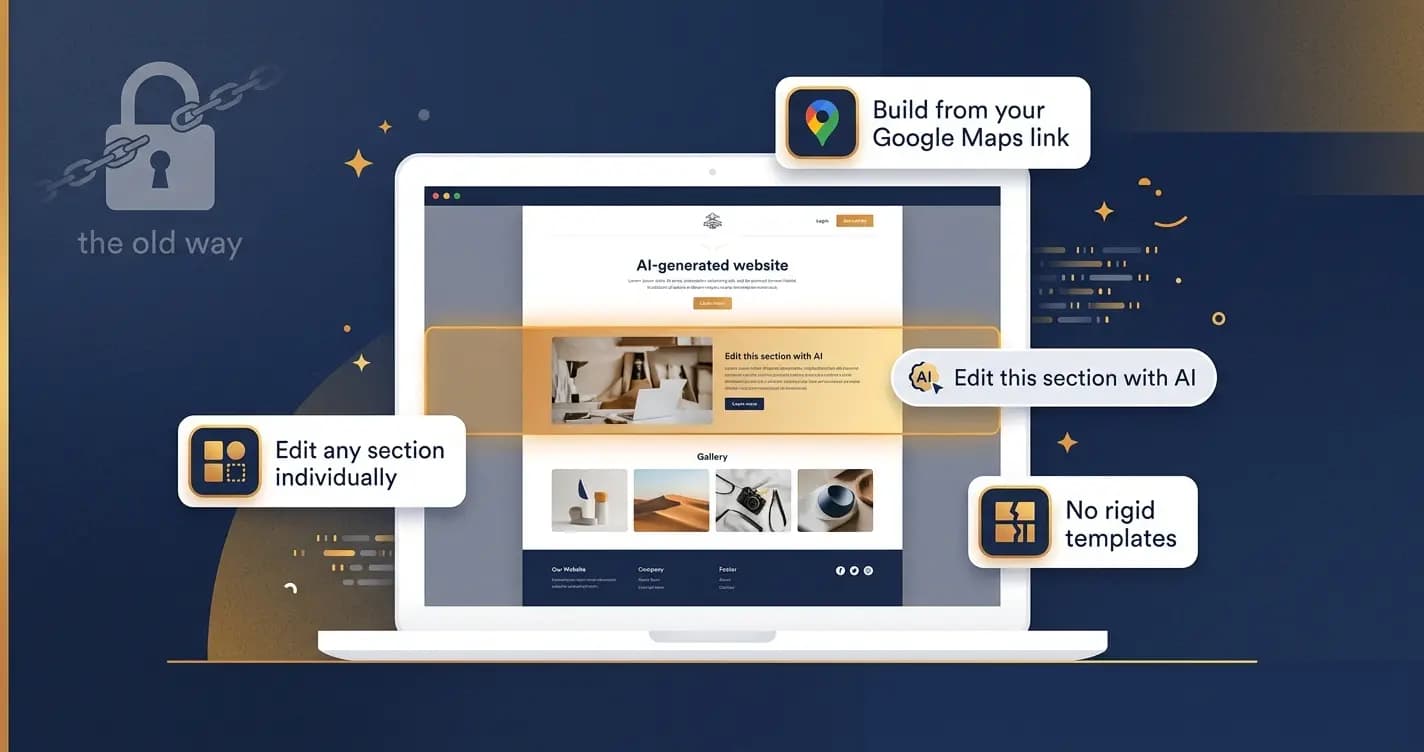
Durable is genuinely good at one thing: getting a website live in about 30 seconds. You describe your business, and it generates a full site with copy, images, and contact details almost instantly. For a lot of people that first moment feels like magic.
The problem shows up on day two, when you try to change something.
This is the most common reason people look for a Durable alternative, and it is not a secret. Reviewers who tested the platform in 2026 describe it the same way: you can swap sections, change colours and fonts, and edit text, but you cannot freely position elements or create truly unique layouts. One in-depth review put it bluntly, noting that most users end up rewriting large sections to make the site feel authentic, because the rigid templates make everything look similar. The speed that felt great on day one becomes a ceiling by the end of the week.
So this guide ranks the 7 best Durable alternatives in 2026 by the thing Durable is weakest at: how much control you actually have after the AI builds your site. Speed to a first draft is table stakes now. Every tool here is fast. What separates them is what happens when you want to change what the AI made.
Why People Look for a Durable Alternative
Durable is a solid product for its target user: a solo service business that wants a simple site plus a CRM and invoicing, launched fast, and rarely touched again. The reasons people outgrow it are consistent across every 2026 review.
Durable limitation | What it means in practice | Source |
Limited editing control | You can edit text, colours, and swap sections, but cannot freely reposition elements or build custom layouts. Most sites end up looking similar. | Butternut AI, Max Productive, 2026 reviews |
Generic AI output | AI-generated copy is often boilerplate and needs rewriting to sound like your brand. | Cybernews, Max Productive, 2026 |
Steep pricing for what you get | Entry plans start around $22 to $25/month, more than several builders that offer more features and deeper customisation. | Butternut AI, Durable review 2026 |
No real ecommerce | Built for service businesses; not suitable for real online stores or large product catalogues. | Butternut AI, mobileappdaily, 2026 |
Closed ecosystem | Third-party integrations beyond the built-in CRM and invoicing are limited or impossible. | Butternut AI, 2026 |
Builds from a text prompt only | You describe your business in words; it does not pull from your real existing business data. | Durable product, 2026 |
The pattern in every review is the same: Durable wins on speed to a first draft and loses on everything that happens after. If you never need to change your site, that trade-off is fine. If you want the site to actually reflect your business and keep evolving with it, editing control is the thing to rank alternatives by. That is exactly what this guide does.
Best Durable Alternatives at a Glance
Best Overall Alternative Entro Per-section AI editing plus builds from your Google Maps link Free to start | Best for Design Control Wix (Harmony AI) AI generation plus full drag-and-drop precision editing From $17/month |
Best for Designers Framer AI plus true design-tool control for unique layouts Free / $5/month | Best No-Code Flexibility Dorik AI Drag-and-drop, white-label CMS, deep integrations From $8/month |
Best Budget Builder Hostinger AI builder with strong value and ecommerce at low cost From $2.99/month | Best for Content Sites Best long-term SEO and content control of any option From $4/month |
Quick Comparison: All 7 Durable Alternatives
Builder | Editing control | Builds from real data | AI per-section editing | Ecommerce | Starting price |
Entro | High (AI + per-section) | Yes (Google Maps link) | Yes | Basic | Free to start |
Wix (Harmony) | Very high (drag-and-drop) | No (prompt) | Partial | Strong | $17/month |
Framer | Very high (design tool) | No (prompt) | Partial | Basic | Free / $5/month |
Dorik AI | High (drag-and-drop) | No (prompt) | Partial | Basic | $8/month |
Hostinger | Medium | No (prompt) | Partial | Yes | $2.99/month |
WordPress.com | Very high (full control) | No | Via plugins | Via WooCommerce | $4/month |
Durable (for reference) | Low (rigid sections) | No (prompt) | No | No | $22/month |
Detailed Reviews: Every Durable Alternative Tested
Ranked by editing control after the AI builds your site. Each review includes a Not right for you if row so you can rule options in or out quickly.
1. Entro
1. Entro Best overall Durable alternative: per-section AI editing plus builds from your real business data | |
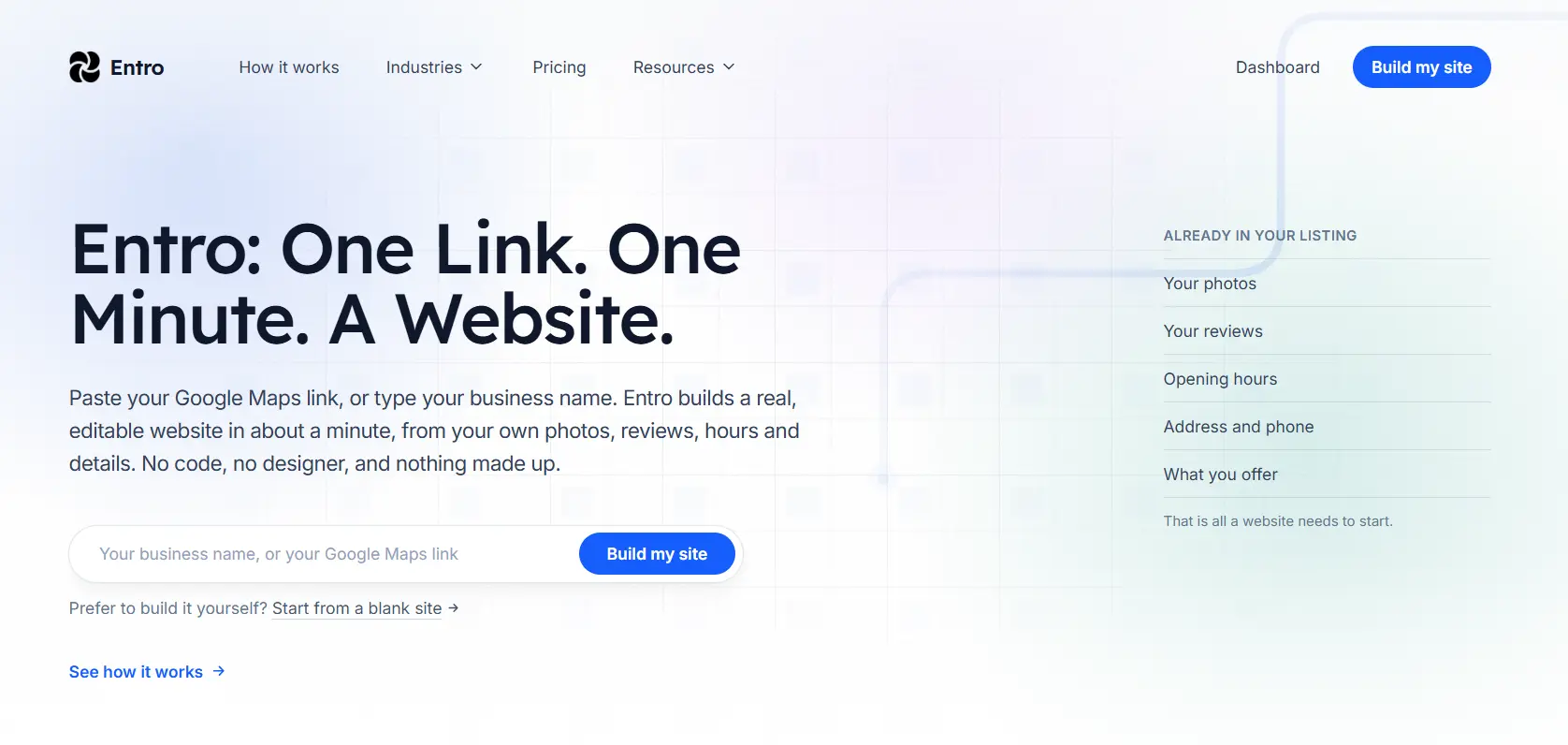
Entro fixes the exact thing Durable gets criticised for. Where Durable generates a site and then locks you into editing rigid sections, Entro lets you edit any section individually with a fast, simple AI editor. Want a different headline? Ask the AI to rewrite just that block. Want the reviews section higher up, a different tone in your about section, or an entirely new section for your services? You change each part on its own, in plain language, without touching the rest of the page. This is the per-section control that Durable users go looking for on day two. | |
The second thing Entro does that Durable cannot: it builds from your real business data, not just a text description. Paste your Google Maps link into the input on the Entro homepage and Entro pulls in your business name, description, photos, and reviews from your Google Business Profile, then turns them into a designed website in about a minute. Durable asks you to describe your business in words and generates from that description, which is a big part of why its output reads generic. Entro starts from what your business actually is, so the first draft is already grounded in your real information. | |
Entro is built for the same person Durable targets, the non-technical business owner who wants a professional site fast, but without the day-two ceiling. You get the 30-second speed and the ability to keep shaping the site with AI, section by section, for as long as you own it. It is free to start, so you can paste your link, see your generated site, and edit it before deciding anything. | |
Pros | Cons |
Per-section AI editing: change any block individually in plain language | Ecommerce is basic: not built for large online stores |
Builds from your Google Maps link, pulling real photos, reviews, and details | Newer platform than Wix or WordPress with a smaller template ecosystem |
First draft is grounded in your actual business data, not a generic prompt | Best suited to business and landing-style sites rather than complex web apps |
Built for non-technical business owners, no design or code skills needed |
|
Free to start: generate and edit before you commit |
|
Fast like Durable, but without the rigid-template ceiling |
|
Not right for you if: you need a full-scale online store with a large product catalogue and advanced inventory. A dedicated ecommerce platform fits that better. | |
Our verdict: The most direct answer to Durable's biggest weakness. You get Durable's speed, plus the per-section AI control Durable lacks, plus a first draft built from your real Google Business Profile data instead of a generic prompt. For the business owner who found Durable too rigid, this is the natural switch. | |
Pricing: Free to start. Paid plans for publishing and custom domains. See entro.work for current pricing. Best for: Non-technical business owners who want a fast AI site they can keep editing section by section, built from their real business data. | |
2. Wix (Harmony AI)
2. Wix (Harmony AI) Best Durable alternative for full design control alongside AI generation | |
Wix Harmony is Wix's AI website builder, powered by an AI agent that works across the whole editor and executes natural-language instructions at any stage of building. What makes Wix the strongest alternative for design control specifically is that it pairs AI generation with Wix's full drag-and-drop editor. You get the speed of AI for the first draft and the precision of manual control for everything after, in one workflow. That combination is exactly what Durable lacks: Durable gives you the AI draft but not the precision editing. | |
The trade-off is complexity and time. Wix takes longer to build a site than Durable, and the sheer number of options can overwhelm absolute beginners. For a business owner who wants the most control and is willing to invest more setup time, Wix is the most capable option here. For someone who wants Durable's simplicity with better editing, Entro is the closer match. | |
Wix also brings the strongest ecommerce of any general builder on this list, a large app market, and mature SEO tools, which makes it a better fit than Durable for businesses that plan to sell products or grow into a larger site over time. | |
Pros | Cons |
AI generation plus full drag-and-drop precision editing in one workflow | Takes longer to build than Durable or Entro |
Strongest ecommerce of any general builder here | Can overwhelm absolute beginners with options |
Large app market and mature SEO tools | Higher cost once you add apps for CRM or advanced tools |
Handles simple sites and complex, growing sites equally well | Builds from a prompt, not from your real business data |
Not right for you if: you want the fastest, simplest path to an editable site. Wix rewards time invested; if you want speed with control, Entro is simpler. | |
Our verdict: The most powerful design-control alternative to Durable. Best when you want maximum control and will invest the extra setup time to get it. | |
Pricing: Free plan available. Paid plans from $17/month. Best for: Business owners who want full design control and ecommerce, and are willing to spend more time building. | |
3. Framer
3. Framer Best Durable alternative for designers who want unique, custom layouts | |
Framer started as a design tool and became an AI website builder, and that heritage shows in how much layout control it gives you. Where Durable constrains you to preset sections, Framer lets you build genuinely custom, distinctive layouts with design-tool precision, plus AI to speed up the first draft. For anyone whose main frustration with Durable is that every site looks the same, Framer is the antidote. | |
The cost of that control is a steeper learning curve. Framer is more design-oriented than Durable or Entro, and a non-technical business owner will feel that. It rewards people who care about design and are willing to learn the tool. The output, in the right hands, is the most visually distinctive on this list. | |
Framer has a generous free tier on a Framer subdomain, which makes it easy to try before committing, and its published sites are fast and modern by default. | |
Pros | Cons |
True design-tool control for unique, custom layouts | Steeper learning curve than Durable, Entro, or Wix |
AI speeds the first draft without locking you into templates | More design-oriented than most business owners need |
Most visually distinctive output on this list in skilled hands | Builds from a prompt, not from real business data |
Generous free tier to learn before committing | Overkill for a simple service-business site |
Not right for you if: you are non-technical and want a site without learning a design tool. Framer rewards design interest; Entro or Wix is friendlier for pure business use. | |
Our verdict: The best choice for design-minded users who found Durable too generic and want full creative control. Not the easiest, but the most expressive. | |
Pricing: Free on a Framer subdomain. Paid plans from around $5/month. Best for: Designers and design-minded founders who want distinctive, custom layouts rather than templated sites. | |
4. Dorik AI
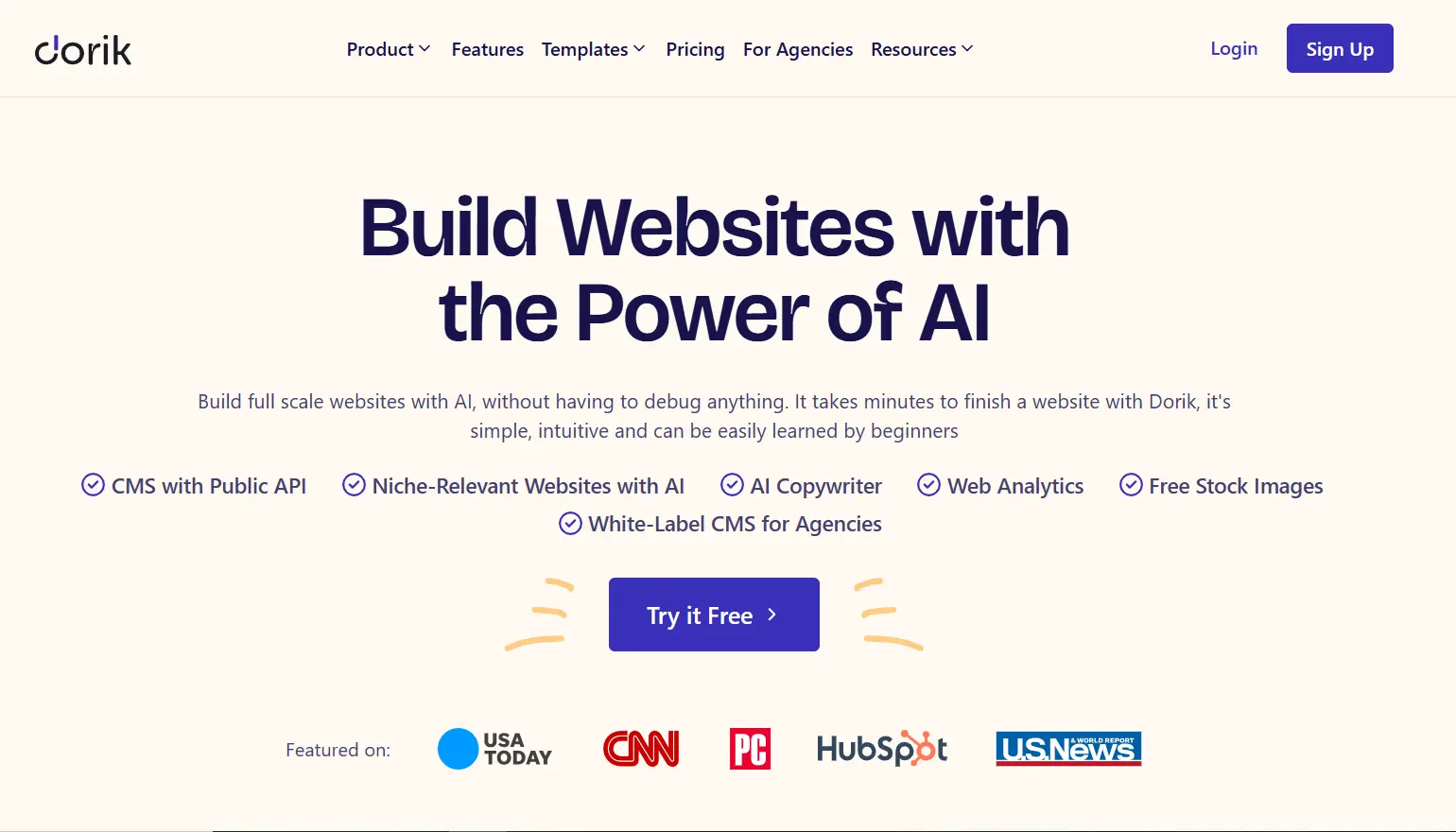
4. Dorik AI Best Durable alternative for no-code flexibility and integrations | |
Dorik AI directly targets Durable's design and customisation limits with a flexible drag-and-drop builder, a white-label CMS, and deep third-party integrations, which is where Durable's closed ecosystem falls short. You can generate a site with AI in minutes and then reshape it with real layout control, or start from one of 100-plus templates, or build from scratch. For users who found Durable both too rigid and too closed, Dorik solves both problems. | |
Dorik also includes AI text and image generation, built-in blogging, and strong SEO settings, and its white-label CMS makes it a favourite among freelancers and agencies who build sites for clients. Pricing starts lower than Durable, which strengthens the value argument. | |
For a solo business owner who just wants a simple site fast, Dorik offers more than they strictly need. Its sweet spot is users who want real flexibility and integrations without going all the way to Wix's complexity. | |
Pros | Cons |
Drag-and-drop editing that solves Durable's rigidity | More features than a simple solo site needs |
White-label CMS: strong for freelancers and agencies | Builds from a prompt, not from real business data |
Deep third-party integrations where Durable is closed | Less mainstream brand recognition than Wix |
100-plus templates plus AI generation and from-scratch building | Some advanced features have a learning curve |
Lower entry price than Durable |
|
Not right for you if: you want the absolute simplest fast-site experience. Dorik's flexibility is its strength but adds surface area; Entro is simpler for a quick business site. | |
Our verdict: A strong flexibility-and-integrations alternative to Durable, especially for freelancers and agencies who build for clients. | |
Pricing: From $8/month. Free trial available. Best for: Freelancers, agencies, and business owners who want no-code flexibility and integrations Durable does not offer. | |
5. Hostinger
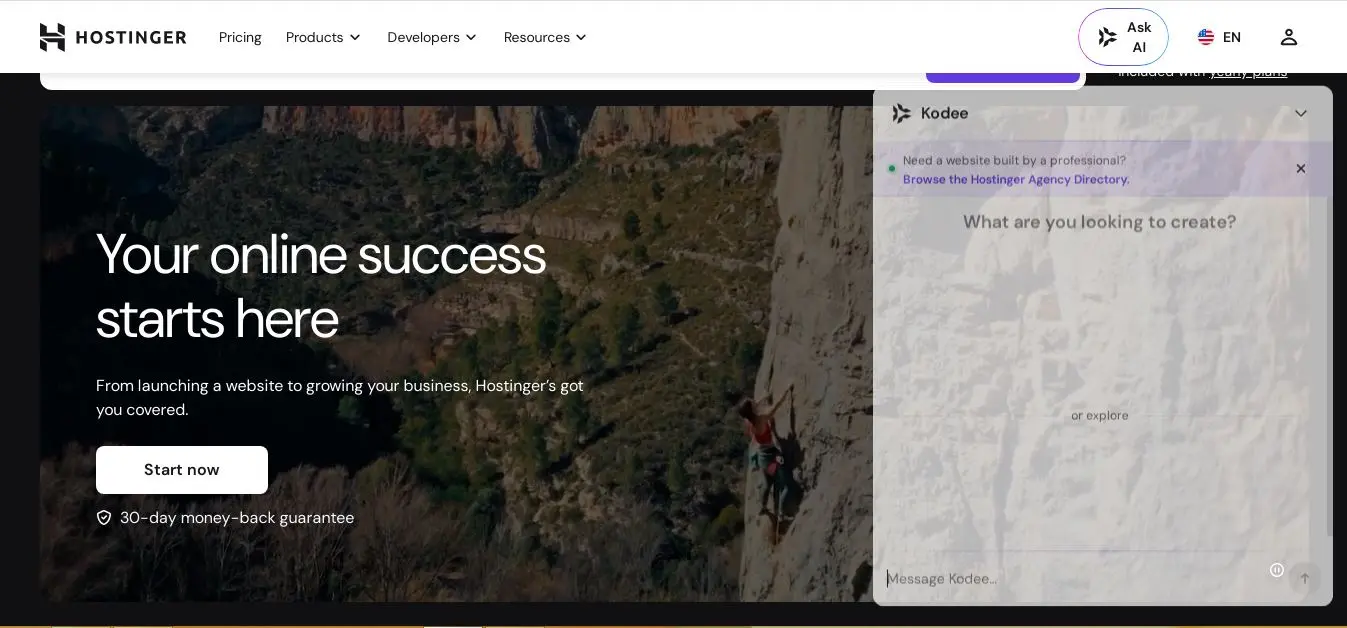
5. Hostinger Best budget Durable alternative with ecommerce | |
Hostinger's AI website builder generates a professional site from a description quickly, includes hosting and a free domain, and starts at a fraction of Durable's price. For a business owner whose main objection to Durable is the $22 to $25/month entry cost, Hostinger delivers a comparable fast-build experience with real ecommerce support at a much lower monthly cost. | |
The editing sits in the middle of this list: more flexible than Durable's rigid sections, less precise than Wix or Framer. For most simple business sites that is enough. Hostinger also handles the technical side (hosting, SSL, security) so you are not managing infrastructure. | |
The honest caveat is renewal pricing, which is significantly higher than the introductory rate, so factor the long-term cost, not just the first-term promotion, into the comparison. | |
Pros | Cons |
Much lower entry price than Durable, from $2.99/month | Renewal pricing much higher than the introductory rate |
Includes hosting, free domain, and SSL | Editing less precise than Wix or Framer |
Real ecommerce support, which Durable lacks | Builds from a prompt, not from real business data |
AI build plus more editing flexibility than Durable's rigid sections | Fewer business tools (no built-in CRM like Durable) |
Not right for you if: you specifically want the built-in CRM and invoicing bundle Durable offers. Hostinger focuses on the website and ecommerce, not business operations tools. | |
Our verdict: The best value alternative to Durable. Lower cost, real ecommerce, and enough editing flexibility for most business sites. | |
Pricing: From $2.99/month introductory. Check renewal pricing before a long-term plan. Best for: Budget-conscious business owners who want a fast AI site with ecommerce at the lowest monthly cost. | |
6. WordPress.com
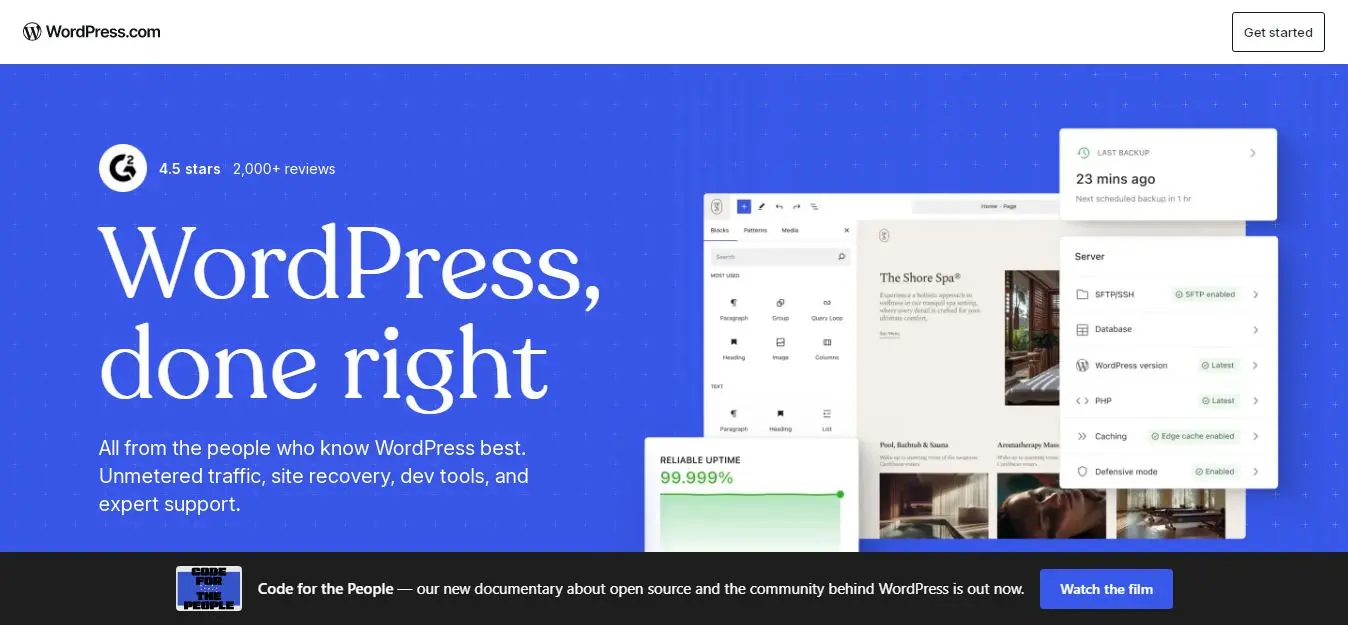
6. WordPress.com Best Durable alternative for content, blogging, and long-term SEO | |
If your frustration with Durable is that you cannot build real content or rank in search beyond your business name, WordPress.com is the answer. It has the best content management and SEO infrastructure of any option here, and with the 2026 plugin expansion on paid plans you can add almost any feature, from ecommerce via WooCommerce to advanced SEO via Yoast or Rank Math. | |
The trade-off is that WordPress is not a 30-second AI builder. It rewards ongoing investment and is more involved to set up and maintain than Durable, Entro, or Hostinger. For a content-driven business, that investment pays back in organic search traffic over time in a way Durable's simple sites cannot. | |
The Personal plan at $4/month is the lowest serious entry point for a platform with this much long-term capability. | |
Pros | Cons |
Best content management and SEO of any option on this list | Not a 30-second AI builder: more setup and maintenance |
60,000-plus plugins on paid plans for almost any feature | Steeper learning curve than Durable or Entro |
Full control over content, structure, and search optimisation | Ecommerce and advanced features require higher plans |
Lowest serious entry price at $4/month | Overkill for a simple one-page service site |
Not right for you if: you want a fast, simple site you rarely touch. WordPress rewards ongoing content work; for a quick set-and-go business site, Entro or Hostinger fits better. | |
Our verdict: The right long-term alternative for content-driven businesses that need SEO depth Durable cannot provide. | |
Pricing: Personal $4/month. Business $40/month for full plugin and ecommerce access. Best for: Content-driven businesses and bloggers who want long-term organic search growth and full control. | |
7. Butternut AI
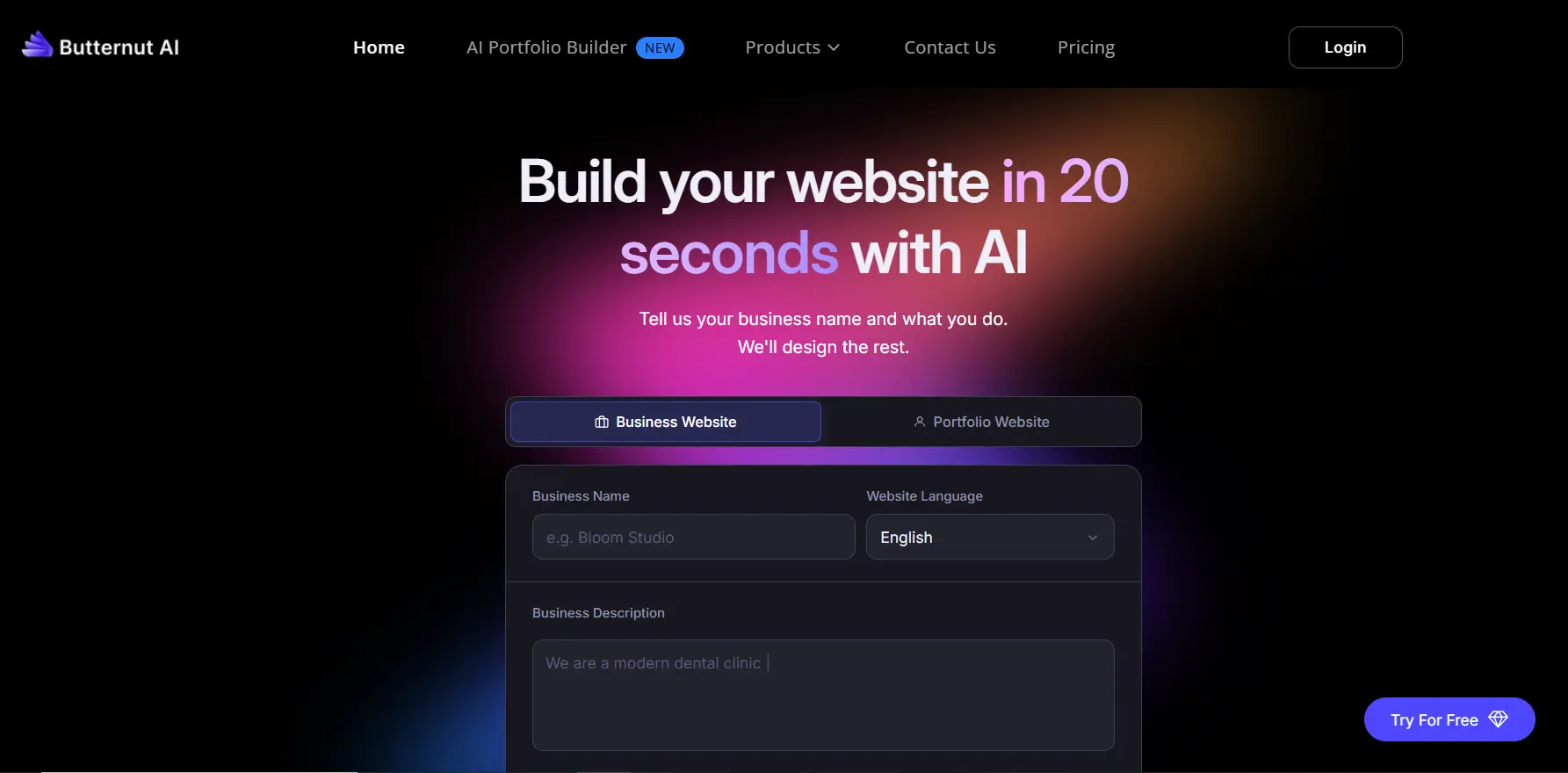
7. Butternut AI Best Durable alternative for chat-based iterative building | |
Butternut AI generates a full site from a description and then lets you keep refining it through a chat-based interface, which is a more flexible editing model than Durable's fixed sections. Updating sections, swapping images, or rewriting copy is direct and does not slow you down the way Durable's rigid templates can. It also offers AI agents for social media, full-length blog generation, and even HTML editing for users who want granular control. | |
As a newer platform, Butternut has a smaller ecosystem and less brand recognition than Wix or WordPress, and its long-term track record is shorter. But for the specific problem of wanting to keep shaping an AI site through conversation rather than fighting a template, it is a capable option. | |
It sits close to Entro in philosophy (keep editing with AI rather than one-shot generation), with the main differences being Entro's per-section editing model and its ability to build from your Google Maps link rather than a text prompt. | |
Pros | Cons |
Chat-based iterative editing, more flexible than rigid sections | Newer platform with a smaller ecosystem and shorter track record |
AI agents for social media and full-length blog generation | Builds from a prompt, not from real business data |
HTML editing available for granular control | Less brand recognition than Wix or WordPress |
Built-in hosting and one-click publishing | Fewer built-in business tools than Durable's CRM bundle |
Not right for you if: you want an established platform with a long track record and large support community. Butternut is newer; Wix or WordPress offers more maturity. | |
Our verdict: A capable chat-based alternative for users who want to keep refining an AI site conversationally rather than editing rigid templates. | |
Pricing: Free to try. Paid plans for publishing and custom domains. Best for: Users who want to build and refine an AI website through conversation with granular control options. | |
Which Durable Alternative Is Right for You
Your situation | Best alternative | Why |
You want Durable's speed but the ability to keep editing every section | Entro | Per-section AI editing plus a first draft built from your Google Maps data |
You have a business on Google Maps and want a site from real data | Entro | Paste your Google Maps link and get an editable site in about a minute |
You want maximum design control and will invest setup time | Wix (Harmony) | AI generation plus full drag-and-drop precision editing |
You are design-minded and want unique custom layouts | Framer | True design-tool control for distinctive sites |
You want no-code flexibility and deep integrations | Dorik AI | Drag-and-drop, white-label CMS, open integrations |
Your main objection to Durable is the price | Hostinger | Comparable fast build with ecommerce from $2.99/month |
You need content depth and long-term SEO | Best content and search infrastructure of any option |
The Fastest Way to Switch From Durable
If the reason you are leaving Durable is that you cannot edit it the way you want, the switch is easy. If your business is on Google Maps, you do not even need to describe it from scratch.
Paste your Google Maps link into the input on the Entro homepage. Entro pulls in your business name, photos, and reviews and builds an editable website in about a minute. Then change any section you want with the AI editor, in plain language, as often as you like.
Paste your Google Maps link at entro.work and get an editable website in about a minute.
Final Note
Durable is not a bad product. It is a fast product with a ceiling. The 30-second build is real, and for someone who wants a simple site they will never touch again, that is enough. The people looking for alternatives are the ones who hit the ceiling: they wanted to change something and found they could not.
Rank your alternative by that exact problem. If you want Durable's speed without the ceiling, and a first draft built from your real business data rather than a generic prompt, Entro is the most direct fix. If you want maximum design control, Wix or Framer. If price is the issue, Hostinger. If content and SEO are the goal, WordPress.
The best test is free on most of these, including Entro. Build the same site on two of them and see which one lets you change what you want. The right tool is the one that does not stop you on day two.
Frequently asked questions
The best overall Durable alternative in 2026 is Entro, because it fixes Durable's most-cited weakness: editing control. Where Durable locks you into rigid sections after it generates your site, Entro lets you edit any section individually with an AI editor in plain language. It also builds from your real business data by reading your Google Maps link, rather than generating from a text prompt like Durable does. For design-focused users, Wix and Framer offer more manual control; for budget users, Hostinger is the value pick; for content and SEO, WordPress.com is strongest.
The most common reason is limited editing control. Durable generates a site fast, but reviewers in 2026 consistently note that you can only edit text, colours, and swap preset sections, without freely repositioning elements or creating custom layouts, so many sites end up looking similar and users rewrite large sections to feel authentic. Other common reasons are generic AI-generated copy that needs rewriting, pricing that feels steep at around $22 to $25/month, no real ecommerce, and a closed ecosystem with limited third-party integrations.
Yes. Entro builds a website from your Google Maps link. Instead of describing your business in a text prompt the way Durable does, you paste your Google Maps link and Entro pulls in your business name, description, photos, and reviews from your Google Business Profile, then generates an editable website from that real data in about a minute. This is why the first draft is more specific to your business and less generic than a prompt-based build.
For pure manual precision, Wix (with Harmony AI) and Framer offer the most control, because they pair AI generation with full design-editing environments (drag-and-drop for Wix, design-tool layout control for Framer). For AI-based editing control specifically, Entro stands out because it lets you re-edit each section individually with AI in plain language, which is the fastest way to keep reshaping a site without learning a design tool. The right answer depends on whether you want manual precision (Wix, Framer) or fast AI editing without a learning curve (Entro).
Several are. Durable's entry plan is around $22 to $25/month. Hostinger starts at $2.99/month (introductory), WordPress.com at $4/month, Framer at around $5/month, and Dorik at $8/month. Entro is free to start. Wix at $17/month is below Durable's entry price for its lowest paid tier. Always check current pricing and, for Hostinger, the renewal rate rather than just the introductory promotion, since renewal costs are higher.
You will rebuild the site on the new platform, but it does not have to be slow or manual. If your business is on Google Maps, the fastest path is to paste your Google Maps link into Entro, which generates an editable site from your existing business data in about a minute, so you are not re-typing everything. On prompt-based builders like Wix, Framer, or Dorik, you describe your business and the AI generates a first draft you then edit. Either way, a simple business site can be rebuilt in well under an hour, and you keep far more editing control afterwards than Durable allows.
Written by
Cyrus
Head of Marketing, Entro
Cyrus writes about mobile app marketing, ASO, and conversion optimization. He's spent the last 3+ years helping indie developers and startup founders get more downloads from organic channels, without paid UA budgets.
Before Entro, he ran growth for two consumer apps that together passed 500,000 downloads on the App Store. Most of what he writes comes from mistakes made with his own money first.
Related articles