7 Best Website Builders for Authors and Writers in 2026 (Ranked Honestly)
A novelist friend asked me to look at her website two years ago. Two published books, a third under contract, a podcast appearance every couple of months, and a site that had not changed since her debut. It had her bio, her book covers, and a contact form. What it did not have was any way for a reader who found her to stay connected.

Cyrus

A novelist friend asked me to look at her website two years ago. Two published books, a third under contract, a podcast appearance every couple of months, and a site that had not changed since her debut.
The site had her bio, her book covers, and a contact form. What it did not have was any way for a reader who found her to stay connected. No newsletter signup. No mailing list. No way to tell the people who liked book one that book two existed.
Every reader who found her through a review, a podcast, or a recommendation landed on that page and left. Some of them probably bought the book. None of them could be reached when book three came out.
We rebuilt the site over a weekend. She added a reader magnet: the first chapter of her debut, free, in exchange for an email address. Within four months she had 2,400 subscribers. When her third book launched, she emailed that list on publication day. Pre-orders doubled compared to her second book, without any additional publisher marketing spend.
That is what an author website is for in 2026. Not a biography page. Not a bookshelf. A direct line to readers that no algorithm, no publisher, and no social media platform can take away.
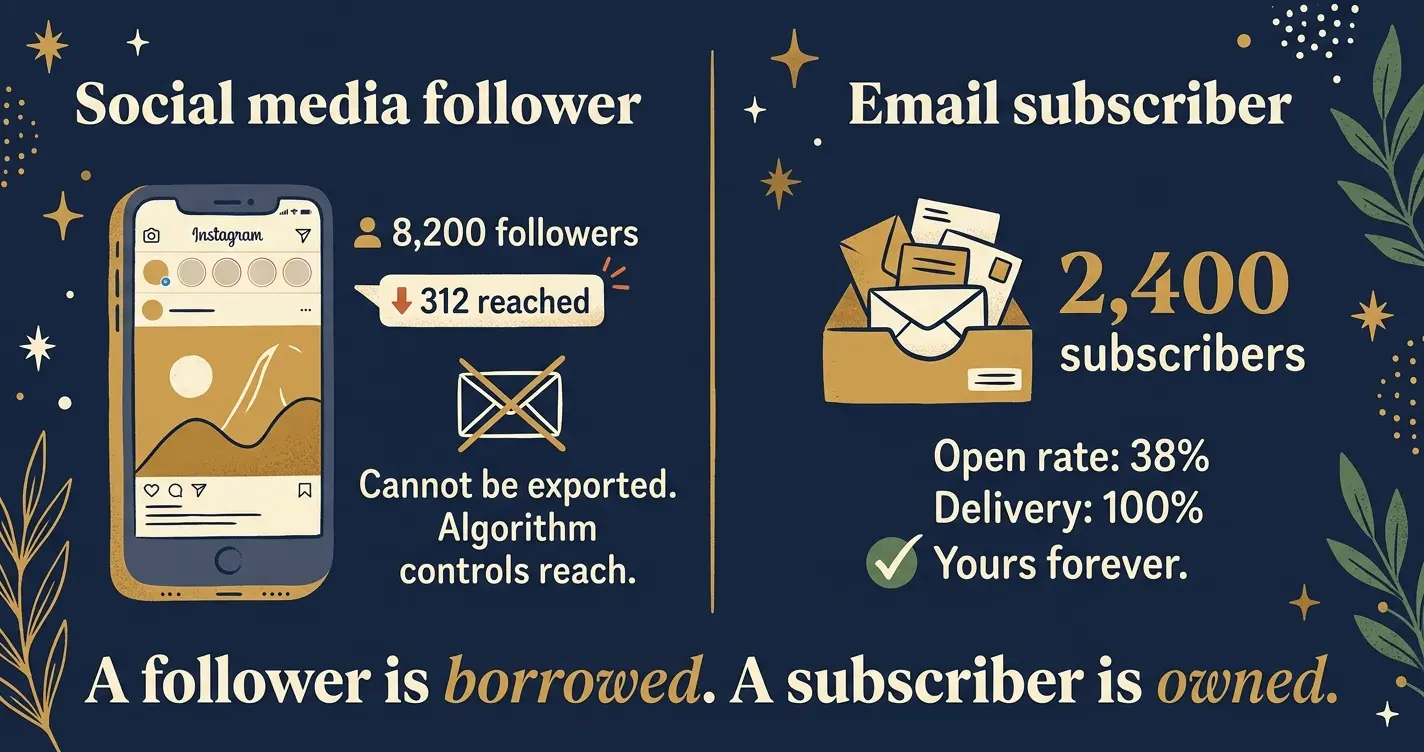
The stakes are real. The average Instagram account reaches roughly 5 to 7% of its followers per post due to algorithmic filtering. An email to your list reaches close to 100%. Authors who understood this early built audiences that survived every platform change from MySpace to Twitter to TikTok. Authors who did not are rebuilding from zero every few years.
This guide covers 7 website builders in 2026, matched to how authors at different stages actually work. Fiction writers have different needs from nonfiction authors. Debut writers have different needs from established ones. The platform you choose should fit your situation, not a generic recommendation.
Fiction vs Nonfiction Authors: Why Your Website Needs Are Different
Most author website guides treat writers as one category. They are not. The jobs your website needs to do depend almost entirely on whether you write fiction or nonfiction.
Goal | Fiction author website | Nonfiction author / expert writer website |
Primary visitor action | Join the mailing list, ideally via a reader magnet (free chapter, bonus story, exclusive content) | Book a speaking engagement, download a media kit, or contact for consulting |
Book page structure | Series order, reading order guide, buy links across all retailers | Buy links, bulk order enquiry form, and a 'for book clubs' or 'for organisations' section |
Content strategy | Newsletter, occasional blog, reader community building | Regular blog or column for SEO and authority, speaking page, press coverage |
Email capture priority | Critical from day one. Reader magnets are the standard strategy in genre fiction. | Important but secondary to credibility signals: press, testimonials, speaking history |
Platform priority | Design quality, newsletter integration, book page clarity | Blog infrastructure, SEO, media kit, booking or consulting page |
Why Your Mailing List Matters More Than Your Social Following
This is the section most author website guides skip because it is uncomfortable to say plainly: your Instagram followers are not yours. Your Twitter audience is not yours. Your TikTok readers are not yours. The platform owns the relationship. You are a tenant.
In 2023, Twitter removed the free API access that many author scheduling tools relied on. Overnight.
In 2024, TikTok faced US ban proceedings. Authors who had built their entire discovery strategy on BookTok had to rebuild.
Instagram's average organic reach for a business account dropped below 5% by mid-2026.
Amazon's Author Central page does not send emails. Goodreads does not send emails. Your publisher does not share the reader data with you.
Your mailing list is the only reader relationship you actually own. When a reader joins your list, their email address is yours. You can email them when a new book launches, when you have a sale, when you are doing an event in their city. No algorithm decides whether they see it. No platform can revoke your access to them.
The authors who are most resilient to platform changes are the ones who built their list when they did not need it. The ones who start building after a platform collapses are always 18 months behind.
Every platform on this list supports a mailing list in some form. What varies is how prominently and how easily. The best author website builders make the newsletter signup the most visible conversion on every page, not a footnote in the footer.
What Every Author Website Needs in 2026
Before choosing a platform, know what you are building. These are the non-negotiable pages and features for a professional author website.
Element | What good looks like | Common mistake |
Newsletter signup | Prominent on homepage, ideally above the fold. Offer a reader magnet (free chapter, short story, bonus content) rather than 'subscribe for updates.' | Putting the signup in the footer only. 'Subscribe for updates' converts at a fraction of what a specific offer converts at. |
Books page | Each book has its own page with cover, blurb, series context, and buy links to all major retailers (Amazon, Barnes and Noble, Bookshop.org, Apple Books, Kobo, IndieBound). | A homepage shelf with covers only. No individual book pages means no SEO from book title searches. |
About page | Two versions of your bio: a short one (2 to 3 sentences) and a long one (3 to 4 paragraphs). Include a professional headshot. Link to media appearances. | A bio that reads like a university application. Readers want to know who you are, not your credentials. |
Events page | Upcoming appearances, signings, speaking events, and book club availability. Updated frequently. | An events page that has not been updated since 2023 is worse than no events page. |
Press and media kit | High-resolution headshots, book covers, short and long bios, interview topics, and a booking contact. Downloadable as a zip file. | No media kit means a journalist or podcast host who wants to feature you has to email you for the basics, and some will not bother. |
Contact page | A simple form and a direct email for media and speaking enquiries. | Just a contact form with no indication of what kind of enquiries you welcome. |
Best Website Builders for Authors at a Glance
Best Overall Squarespace Best design quality with Acuity or Mailchimp for newsletter From $16/month | Best for Newsletter-First Ghost Built for paid subscribers and serialised publishing From $9/month |
Best for SEO and Blogging Best content infrastructure for writers who publish regularly From $4/month | Best All-in-One Wix Portfolio, events, blog, and email in one platform From $17/month |
Best Author-Specific Tertulia ISBN import builds your site automatically from book data From $19/month | Best Budget Option Hostinger AI-generated author site at the lowest monthly cost From $2.99/month |
Quick Comparison: All 7 Builders
Builder | Newsletter | Book pages | Blog / SEO | Events | Paid subscriptions | Starting price |
Squarespace | Via integration (Mailchimp, ConvertKit) | Yes, clean display | Good | Via integration | No | $16/month |
Ghost | Native (best on list) | With add-ons | Excellent | No | Yes (native) | $9/month |
WordPress.com | Via Jetpack / plugins | Yes | Best on list | Via plugins | Via plugins | $4/month |
Wix | Via Ascend / integrations | Yes | Good | Yes (native) | Via apps | $17/month |
Tertulia | Native | Automatic (ISBN import) | Basic | Yes | No | $19/month |
Hostinger | Via integration | Basic | Good | No | No | $2.99/month |
Webflow | Via integration | Flexible (CMS) | Excellent | Via CMS | No | $14/month |
Detailed Reviews: Every Builder Tested
Each review includes a 'Not right for you if' row so you can eliminate options quickly. The goal is to find your answer in one read, not to make every platform sound appealing.
Squarespace
1. Squarespace Best overall website builder for authors who want design quality without complexity | |
Squarespace is the platform I most consistently recommend to authors in mid-career who want a site that looks serious without requiring weeks of setup. The templates with strong typography (particularly Paloma, Clune, and Hester) are editorial, whitespace-generous, and text-forward in a way that suits an author's visual identity. The book page layouts display covers and blurbs cleanly. And Blueprint AI, Squarespace's 2025 AI site generator, builds a coherent starting design from a description of your writing and publishing history in under 15 minutes. | |
The newsletter situation requires one decision upfront: Squarespace's own email marketing tool (Squarespace Email Campaigns) is functional but limited. Most authors who are serious about their list use Mailchimp, ConvertKit, or Kit (formerly ConvertKit) integrated with Squarespace. The integration is straightforward, but it does mean a second subscription. For a debut author who is just starting to build a list, Squarespace's native tool is enough. For an established author with 5,000 plus subscribers who needs automation, tagging, and segmentation, a dedicated email platform connected via integration is the right setup. | |
One feature that most author website guides miss entirely: Squarespace's scheduling tool (Acuity) integrates directly for authors who do speaking, workshops, or book club appearances. Rather than an events page where readers have to email for availability, you can embed a live booking calendar. For authors who do regular school visits, library events, or writing workshops, this converts visitor interest into confirmed bookings automatically. | |
Pros | Cons |
Best typography and editorial templates for author visual identity | Native email tool limited for authors with large or segmented lists |
Blueprint AI generates a coherent author site from a writing description fast | No built-in reader magnet delivery or BookFunnel integration out of the box |
Clean, professional book page layouts with cover display and multi-retailer links | Template cannot be changed once the site is live without rebuilding |
Acuity Scheduling for book club and speaking bookings built in | No paid subscription or serialised content capability natively |
Strong third-party newsletter integrations (Mailchimp, ConvertKit, Kit) |
|
14-day free trial, no credit card required |
|
Not right for you if: you are primarily a genre fiction author building a reader community around paid subscriptions or serialised content. Ghost is the right tool for that model. | |
Our verdict: The strongest general author website platform for design quality and professional credibility. The newsletter integration requires a second subscription for serious list management, but the overall setup is the most polished on this list. | |
Pricing: Personal $16/month. Business $23/month. 14-day free trial. Add Mailchimp or ConvertKit from free tiers upward. Best for: Mid-career and established authors who want a professional, well-designed site and are comfortable using a third-party email platform for their list. | |
Ghost
2. Ghost Best website builder for authors who want a paid newsletter or subscriber community | |
Ghost is an open-source publishing platform built specifically for newsletters, memberships, and paid subscriptions, and it is the platform to use when your primary revenue model is reader-supported rather than publisher-advance-supported. If you are writing serialised fiction, sending weekly essays to paid subscribers, or building a Substack-style reader community around your work, Ghost is the only platform on this list designed natively for that model. | |
The newsletter delivery, subscriber management, payment processing, and website are all one integrated system with zero transaction fees on memberships. A reader can go from landing on your site to becoming a paying subscriber in under two minutes. Free tiers let readers engage with some content. Paid tiers unlock the rest. For genre fiction authors building a Patreon-style model around early chapters, bonus content, and reader community, Ghost does this more cleanly than any alternative, including Substack, because you own your domain, your subscriber data, and your content without platform lock-in. | |
The design is clean and reading-focused by default, which suits an author. The templates prioritise the text rather than the decoration, which is exactly right for a writer. The SEO infrastructure for blog and newsletter content is strong. The honest limitation: Ghost is not the right choice if you primarily need beautiful book showcase pages and a static professional site. It is optimised for publishing ongoing content, not for displaying a backlist. Authors who need both a professional site and a subscriber community sometimes use Ghost for the newsletter and a separate static page for the book showcase. | |
Pros | Cons |
Native newsletter, membership, and paid subscription tools in one system | Less visually polished book showcase pages than Squarespace |
Zero transaction fees on memberships and paid content at all tiers | Better for publishing ongoing content than displaying a static backlist |
Best platform for serialised fiction, paid essays, and reader-supported models | No booking or events integration natively |
Strong SEO for newsletter and blog content | Self-hosted Ghost requires technical setup; Ghost Pro is simpler but costs more at scale |
Full data ownership: subscriber list is always exportable |
|
Open-source: self-hosted Ghost is free, managed Ghost Pro starts at $9/month |
|
Not right for you if: your primary goal is a professional author profile page with a clean book display and no plans for a paid subscriber community. Squarespace does that job better. | |
Our verdict: The only platform on this list purpose-built for the reader-supported author model. If your strategy involves paid subscribers, serialised content, or a membership community around your writing, Ghost is the right investment. | |
Pricing: Ghost Pro from $9/month (Starter, up to 500 members). $25/month (Creator, up to 1,000 members). Self-hosted Ghost is free. Best for: Authors building a paid reader community, serialised fiction writers, and essayists with a newsletter-first publishing strategy. | |
WordPress.com
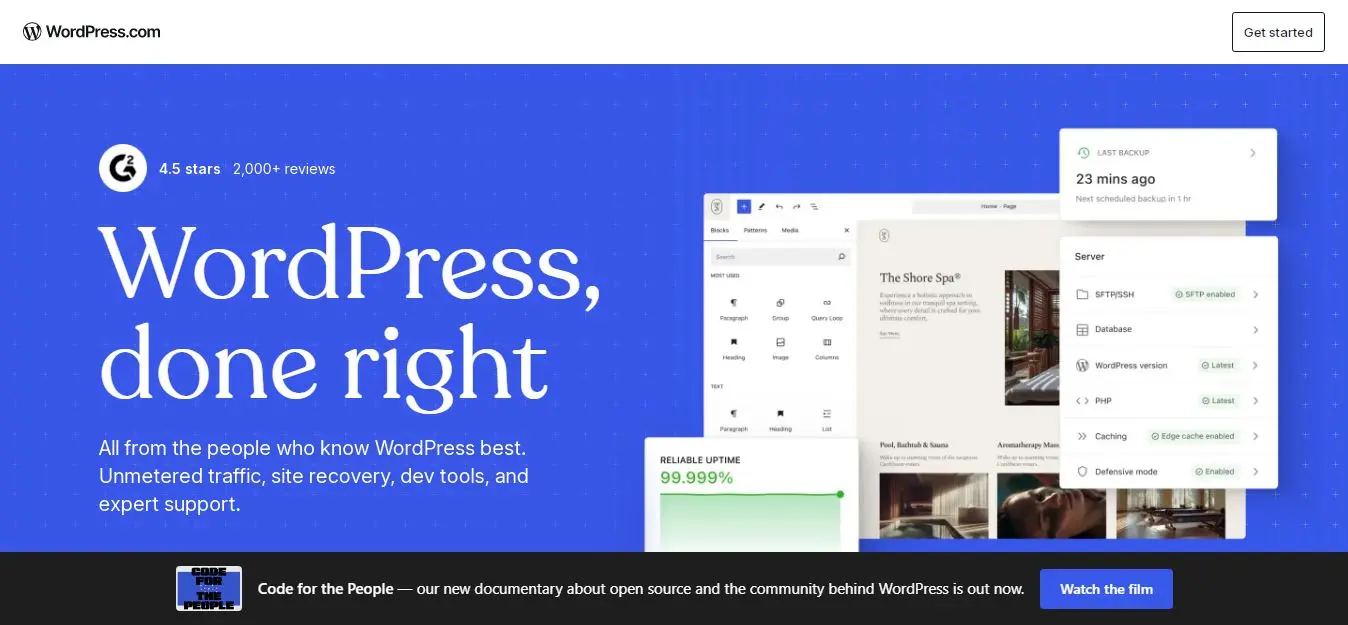
3. WordPress.com Best website builder for authors who blog regularly and want long-term SEO | |
WordPress powers 43.4% of all websites on the internet (W3Techs, 2025) and it is the platform of choice for writers who take their online presence seriously as a long-term investment. The blogging infrastructure is the most capable of any option on this list: category and tag management, a powerful search system, long-form post formatting, and the editorial credibility that comes from being the platform most serious writers and publishers use. If you maintain a regular blog as part of your reader relationship strategy, no other platform handles a large body of text-based content as well as WordPress. | |
The SEO infrastructure is the strongest on this list when properly configured. With Yoast SEO or Rank Math installed, every book page, every blog post, and every author event page can be optimised with meta titles, descriptions, and schema markup that help your name and your books appear in Google searches. For nonfiction authors who rely on Google as a discovery channel, this matters more than design quality. A nonfiction author who ranks on page 1 for their book's key topic gets inbound leads from Google. A nonfiction author on a beautiful Squarespace site with no SEO strategy gets none. | |
The April 2026 update that unlocked 60,000 plus plugins on all paid plans was a significant improvement. Authors can now add BookFunnel integration, WooCommerce for direct book sales, event management, and advanced email automation without upgrading to the highest plan tier. The Personal plan at $4/month is genuinely functional for a debut author who wants a professional web presence at minimum cost. | |
Pros | Cons |
Best blogging and content management infrastructure of any builder on this list | Less visually polished out of the box than Squarespace for book showcase pages |
Strongest SEO tools when combined with Yoast or Rank Math | Ecommerce for direct book sales requires the $40/month Business plan minimum |
60,000 plus plugins available on paid plans since April 2026 | More complex to configure than Squarespace or Wix for non-technical authors |
Most trusted platform for editorial credibility with journalists and publishers | Newsletter requires third-party integration even on paid plans |
Personal plan at $4/month is the lowest serious entry point on this list |
|
Not right for you if: you are a fiction author who does not blog regularly and whose primary goal is a beautiful book display site. Squarespace serves that better with less configuration work. | |
Our verdict: The right long-term platform for authors who publish regular content and want their website to work as a discovery engine over time. The SEO infrastructure rewards consistent investment in a way no other platform on this list matches. | |
Pricing: Personal $4/month. Premium $18/month. Business $40/month (required for ecommerce and full plugin access). Best for: Nonfiction authors, bloggers, and writers who publish regularly and want their website to generate organic discovery through Google over time. | |
Wix
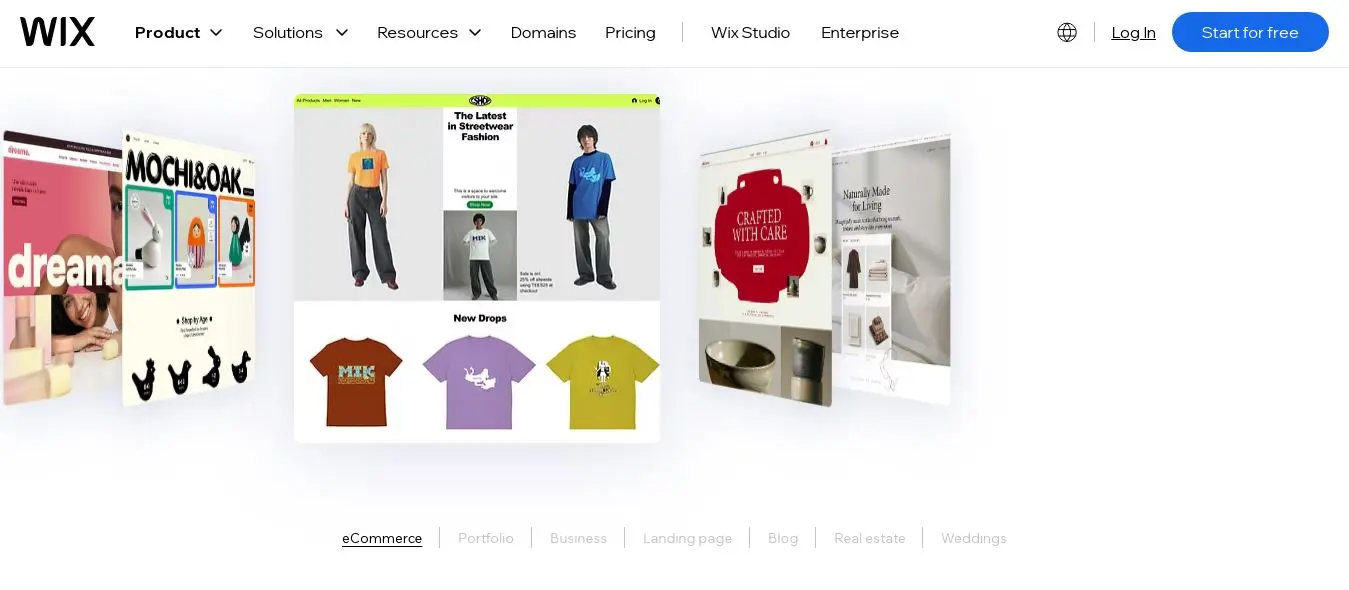
4. Wix Best all-in-one author website builder for multiple functions in one platform | |
Wix is not the most design-forward platform for authors and it is worth saying that plainly. Squarespace produces more typographically refined output. Ghost is better for paid newsletters. WordPress is stronger for SEO. But Wix handles more functions in one place than any other option on this list, which matters for authors who need their website to do several things simultaneously without managing multiple subscriptions. | |
The Wix Events app handles author appearances, book signings, and speaking bookings with registration and reminder emails built in. The Wix Blog handles regular content with SEO tools included. Wix Ascend covers email marketing and audience management without a third-party email platform subscription. The App Market adds BookFunnel integration, WooCommerce-style store functionality, and community features without switching platforms. For an author who runs workshops, sells merchandise alongside books, has a newsletter, and manages a speaking calendar, Wix's ecosystem covers all of it. | |
The AI website builder in 2026 generates a starting design from a description of your writing in minutes. For an author who has been putting off building a website because starting feels overwhelming, the AI removes that barrier effectively. The result needs editing, but it is a genuine starting point rather than a blank canvas. | |
Pros | Cons |
Events and ticketing via Wix Events for author appearances and signings | Less typographically refined than Squarespace for literary aesthetics |
Email marketing via Wix Ascend without a separate subscription | Template cannot be changed after the site goes live |
App Market for BookFunnel, store, and community features | Pages are not exportable if you decide to leave the platform |
AI website builder generates a starting design from a writing description | Feature richness can feel overwhelming for authors who only need a simple book site |
Free plan available for experimenting before committing to paid |
|
Not right for you if: you are a debut author who only needs a book page, a bio, and a newsletter signup. That is a 3-page Squarespace site, and the simplicity will serve you better than Wix's feature set. | |
Our verdict: The right platform for authors who run a full business alongside their writing: workshops, speaking, merchandise, and newsletter. For authors who only need a website, Wix offers more than they need at this price. | |
Pricing: Free plan. Light $17/month. Core $29/month. Business $36/month. Best for: Authors who run events, workshops, or a merchandise operation alongside their writing and want one platform for everything. | |
Tertulia
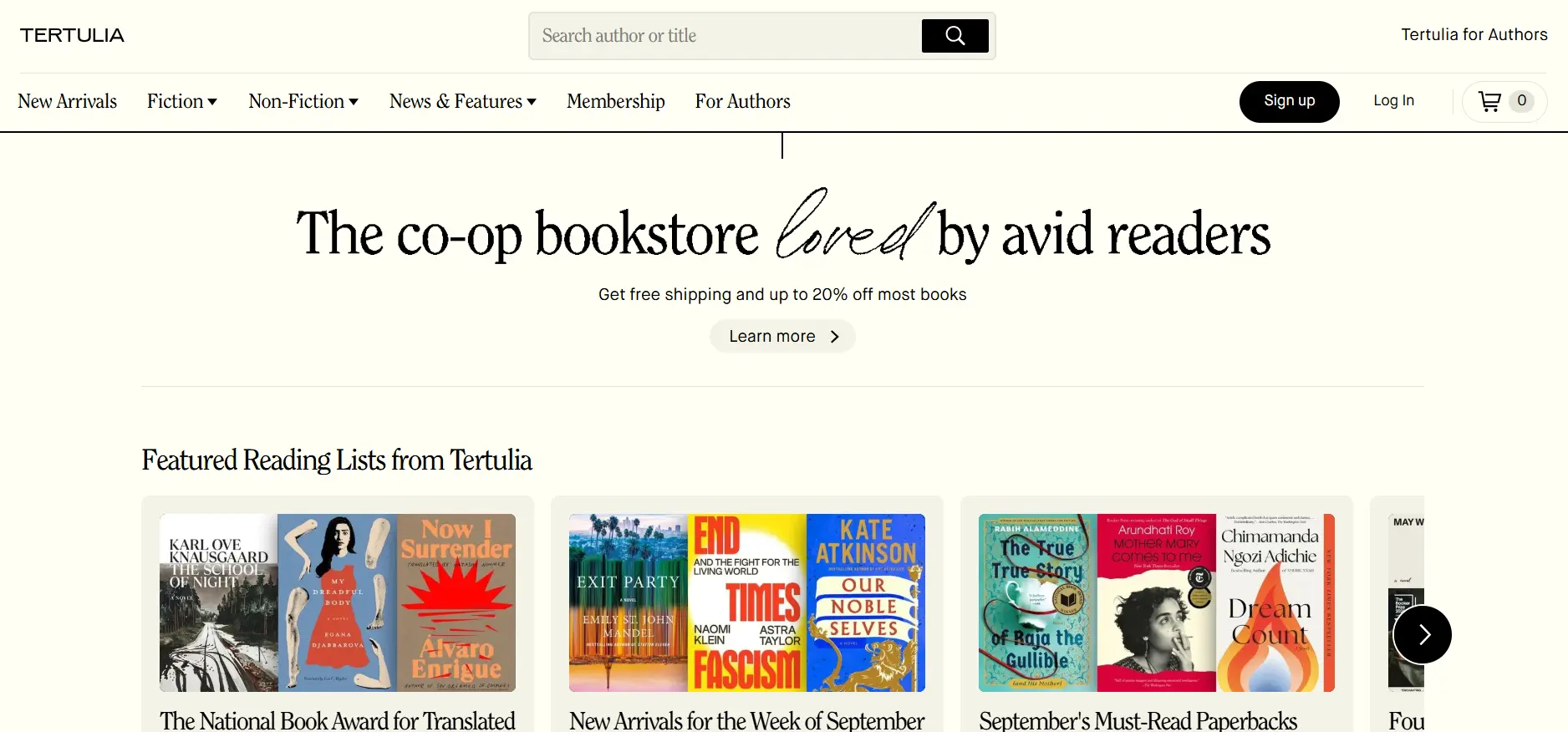
5. Tertulia Best purpose-built author website platform with automatic book data import | |
Tertulia is the most author-specific platform on this list. You enter your book's ISBN and it imports your cover, blurb, publisher information, retailer links, and existing reviews automatically. Your book pages are built from the data that already exists online rather than from manual entry. For an author with a backlist of 8 novels who has been dreading building a website because of the data entry involved, Tertulia's import system removes the single biggest practical barrier. | |
The platform also integrates with Bookshop.org and other independent retailer networks natively, which matters for authors who want to support independent bookstores alongside Amazon sales. The blog, events, email, and storefront features are all included in one subscription without requiring separate tools. The design is clean and book-forward. The setup is the fastest of any platform on this list for an author with existing published work. | |
The honest trade-off is that Tertulia is a newer and smaller platform than Squarespace, WordPress, or Wix. The design flexibility is more limited. The plugin ecosystem does not exist in the way it does for WordPress. And at $19/month it is more expensive than Squarespace Personal or WordPress. What you pay for is the time saved on setup and the author-specific features that general builders make you configure manually. For an established author who values their time over customisation flexibility, the premium is often worth it. | |
Pros | Cons |
ISBN import: cover, blurb, retailer links, and reviews built automatically | Less design flexibility than Squarespace or Wix |
Native Bookshop.org integration for independent retailer support | Newer platform with a smaller community and support ecosystem |
Blog, events, email, and storefront in one author-specific platform | More expensive than Squarespace Personal at $19/month |
Fastest setup time for authors with existing published work | No plugin ecosystem for adding custom features |
Designed specifically for authors, not adapted from a general builder |
|
Not right for you if: you are a debut author with no published books yet. The ISBN import feature that makes Tertulia valuable requires an existing publication. Start with Squarespace or Hostinger and switch to Tertulia when you have books to import. | |
Our verdict: The best platform for published authors who want their book data to drive the website rather than building it manually. The ISBN import alone saves most authors 3 to 4 hours of setup time per book. | |
Pricing: From $19/month. Contact Tertulia for current plan details at authors.tertulia.com. Best for: Published authors with a backlist who want a fast, professional site built around their books with minimal manual data entry. | |
Hostinger
6. Hostinger Best budget option for debut authors who need a professional web presence quickly | |
Hostinger's AI website builder generates a professional-looking author site from a short description of your writing in under a minute. At $2.99/month with a free domain and SSL included, it is the lowest-cost route to a professional web presence for a debut author who needs something credible online before a media appearance, a pitch, or a launch. | |
The honest position on Hostinger for authors: it is a starting point, not a permanent home. The newsletter tools are basic and require third-party integration for anything beyond simple list building. The book page display is functional rather than impressive. The SEO infrastructure is less developed than WordPress. But for an author in year one of their publishing journey who needs a URL they can put in a query letter or a podcast bio before investing more significantly, Hostinger provides that at a price that respects the financial reality of being a debut writer. | |
The path most authors follow with Hostinger is to use it for 12 to 18 months while they are building their first reader base, then migrate to Squarespace or WordPress when the business of being an author generates enough revenue to justify the investment. The migration is not seamless but it is not catastrophic either: a 5-page author website takes a weekend to rebuild, and the mailing list migrates independently through the email platform. | |
Pros | Cons |
From $2.99/month: lowest cost entry point on this list | Newsletter tools basic, requires third-party integration for serious list management |
AI generator creates a working author site from a description in under 1 minute | Book page display functional but not visually impressive |
Free domain and SSL included on most plans | Less SEO depth than WordPress for authors who want long-term organic discovery |
Fast to live: suitable for authors who need a URL this week | Renewal pricing significantly higher than the introductory rate |
Clean, readable templates adaptable for author websites |
|
Not right for you if: you are an established author or someone with more than one book to display. Squarespace or Tertulia gives you a better result that does not need replacing in 18 months. | |
Our verdict: Right for debut authors who need a professional web presence at minimum cost. Use it as a launchpad, build your list, and upgrade when the writing income justifies it. The only mistake is treating it as permanent. | |
Pricing: From $2.99/month (introductory). Check renewal pricing before committing to a multi-year plan. Best for: Debut authors who need a professional URL and author site at minimum cost while their publishing career is getting started. | |
Webflow
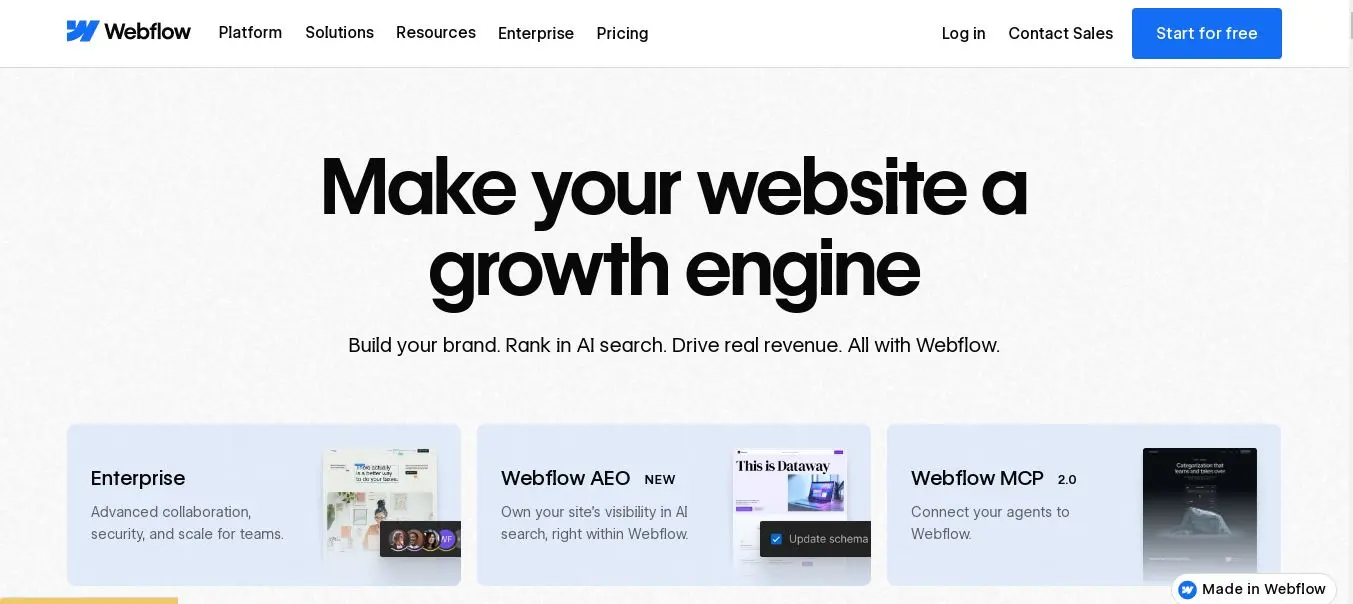
7. Webflow Best for authors who want a custom, design-led site and are willing to invest in learning | |
Webflow is on this list for a specific type of author: the writer who is also design-literate, who cares deeply about how their website looks and behaves, and who is willing to invest a week or more in learning a new tool to get a result that is genuinely custom. The visual editor produces clean, professional HTML without writing code, but the learning curve is real. This is not a platform you are live on by the end of a weekend without prior experience. | |
The CMS is built in for managing a book catalog, a blog, or a series of writing samples without rebuilding pages manually. For a literary fiction author whose aesthetic identity is central to their brand, or an essayist whose writing website is itself a piece of design work, Webflow gives the most control over how that identity is expressed online. The interaction animations, the typography controls, and the layout precision are all available without code. | |
The practical consideration: most authors do not need this level of control and the time investment is not justified by the incremental improvement over Squarespace for a standard author website. Webflow earns its place for authors who would otherwise hire a developer to achieve a custom result, where the cost of the developer would exceed the cost of learning Webflow. | |
Pros | Cons |
Most visual design control of any no-code builder on this list | Steepest learning curve on this list, not suitable for non-technical authors |
CMS for managing book catalog and blog content without manual page rebuilding | No purpose-built author features: book pages, events, and newsletters all require custom configuration |
Interaction animations for authors who want their site to feel premium | More expensive at commercial tiers than Squarespace or WordPress |
Free plan on Webflow subdomain for learning before committing | No reader magnet delivery or newsletter automation built in |
Best choice for authors who would otherwise pay a developer for a custom site |
|
Not right for you if: you are not comfortable investing significant time learning a new tool. The time is better spent writing. Use Squarespace. | |
Our verdict: The right choice for design-literate authors who want a genuinely custom site and are willing to treat the platform as a creative tool rather than a utility. For everyone else, the learning investment exceeds the benefit. | |
Pricing: Free (Webflow subdomain). Basic $14/month. CMS $23/month. Business $39/month. Best for: Design-literate authors, literary writers, and essayists who want their website to reflect a distinctive visual identity and are willing to invest time in learning the platform. | |
Which Platform Is Right for You: A Decision Framework
Your situation | Best platform | Key reason |
Debut author, need a URL this week at minimum cost | Hostinger | From $2.99/month, AI builder live in under 1 minute, upgrade later |
Fiction author building a reader community and mailing list | Squarespace + ConvertKit | Best design quality with the strongest newsletter platform integrated |
Author with a paid subscriber model or serialised content | Ghost | Only platform built natively for paid reader subscriptions |
Nonfiction author or writer who blogs and needs SEO | WordPress.com | Best content infrastructure and SEO tools for regular publishers |
Published author who wants fast setup from existing book data | Tertulia | ISBN import builds book pages automatically, no manual entry |
Author who runs events, workshops, and merchandise | Wix | Most features in one platform for multi-function author businesses |
Design-literate author who wants a fully custom site | Webflow | Most visual control, requires significant learning investment |
5 Author Website Mistakes That Quietly Cost You Readers
Mistake | What it costs you | How to fix it |
No newsletter signup above the fold | Every reader who visits and leaves is lost permanently. You have no way to tell them about your next book. | Put the newsletter CTA on your homepage, above the fold. Offer a specific reader magnet, not 'subscribe for updates.' |
No individual book pages, only a homepage shelf | Your book titles cannot rank in Google searches. A reader who Googles your book title finds Amazon, not you. | Give every book its own page with the title as the H1, a full blurb, buy links, and any press quotes. |
Social links but no email capture | You are building an audience on someone else's platform. When that platform changes its algorithm or disappears, so does your audience. | Treat the mailing list as the destination. Use social to drive traffic to your site, not as the end point. |
An events page that has not been updated in over a year | It tells every visitor that you are not active. A blank slate is better than outdated information. | Either update it every time something changes, or remove it until you have upcoming events to list. |
No press kit or downloadable media kit | Journalists, podcast hosts, and event organisers who cannot find what they need quickly will move on to the next author on their list. | Add a press page with downloadable headshots (high-res JPG), book covers (high-res PNG), and a short and long bio in a single zip file. |
Final Note
My novelist friend now has 2,400 subscribers. When her third book launched, she emailed them on publication day. Pre-orders doubled compared to her second book, without a dollar of additional marketing spend. The website cost her a weekend to build and $23 a month to run. Every reader on that list found her through her work, not through a paid ad. They are hers.
That is what the right author website does. It converts the readers who find you into readers who stay connected. No algorithm. No platform dependency. Just a direct line from your writing to the people who want to read it.
Start simple. A homepage with a reader magnet, a books page for each title, and an about page is enough to launch. The newsletter list you build from day one is the asset that compounds. The rest of the website is the frame around it.
Frequently asked questions
Squarespace is the best general-purpose author website builder for most writers in 2026, offering polished design, clean book page layouts, and strong third-party newsletter integrations. Ghost is the better choice for authors building a paid subscriber or membership model around their writing. WordPress.com is best for nonfiction authors and bloggers who publish regularly and want strong long-term SEO. Tertulia is the fastest setup for published authors who have existing books, using ISBN import to build book pages automatically. No single platform is the right answer for every author.
Yes. Social media followers are not owned by you. Instagram's algorithm reaches 5 to 7% of your followers per post. TikTok faced potential ban proceedings in 2024. Twitter's API access for third-party tools was revoked overnight in 2023. Your website and the mailing list it builds are the only reader relationships you actually own. Every reader who joins your list receives your emails at close to 100% delivery rate, regardless of what any platform's algorithm decides. Authors who have been building their lists for 5 years have audiences that survived every platform change. Authors who have not are always starting over.
At minimum: a homepage with a newsletter signup and a clear reader magnet offer, an individual page for each book with cover, blurb, and buy links to all major retailers, an about page with a short bio and a professional headshot, and a contact page. Beyond the minimum: an events page for appearances and signings, a press page with downloadable media kit, a blog if you publish regularly, and a reading order guide if you write series. The newsletter signup is the most important element. A homepage that converts visitors into subscribers is worth more than a beautiful homepage that does not.
Costs range from $2.99/month (Hostinger, introductory) to $23/month (Squarespace Business) plus the cost of a newsletter platform if you use a third-party tool. Most authors run a professional website for $15 to $45 per month all-in. The most common setup for a working fiction author is Squarespace Personal at $16/month plus ConvertKit free tier (up to 10,000 subscribers at no cost), totalling $16/month. Ghost Pro covers the website and the newsletter together from $9 to $25/month. Hostinger is the starting point at $2.99/month before renewal pricing applies.
Squarespace if you want to be live with a polished, professional site in a day and are not planning to maintain a regular blog. The setup is faster, the design quality is higher out of the box, and the ongoing maintenance is simpler. WordPress if you blog regularly and want your website to work as a long-term SEO asset, or if you need deep customisation that Squarespace's template system does not allow. The majority of fiction authors who primarily need a book showcase site and a newsletter signup are better served by Squarespace. The majority of nonfiction authors and regular bloggers are better served by WordPress.
A reader magnet is a piece of content you offer free in exchange for a reader's email address. For fiction authors, this is typically the first chapter of a book, a short story set in the same world as your series, or an exclusive novella. For nonfiction authors, it might be a checklist, a sample chapter, or a resource related to your book's topic. The conversion difference between 'subscribe for updates' and a specific reader magnet offer is substantial. 'Subscribe for updates' converts at 1 to 3% of visitors. A compelling reader magnet offer converts at 5 to 15%. For an author receiving 500 visitors per month, that difference is 5 new subscribers versus 75. Compounded over a year, the mailing list built with a reader magnet is categorically larger.
Yes, on most platforms on this list. Squarespace Commerce and Wix eCommerce both support direct book sales with zero transaction fees on paid plans. WordPress.com requires the Business plan at $40/month for WooCommerce. Ghost supports direct digital downloads and memberships natively. The consideration for direct book sales is whether the benefit of keeping 100% of the revenue outweighs the friction of asking a reader to checkout on an unfamiliar site rather than clicking through to Amazon. Most authors use both: retailer links for physical books and discoverability, direct sales for signed copies, special editions, and digital products where the margin justifies the conversion effort.
Written by
Cyrus
Head of Marketing, Entro
Cyrus writes about mobile app marketing, ASO, and conversion optimization. He's spent the last 3+ years helping indie developers and startup founders get more downloads from organic channels, without paid UA budgets.
Before Entro, he ran growth for two consumer apps that together passed 500,000 downloads on the App Store. Most of what he writes comes from mistakes made with his own money first.
Related articles